
 John Ward
You reach into the back of the wardrobe for a bag you have not used since March, and it has gone grey and furry. Here is the short version, and it contradicts most of what you will read on leather brand blogs. Make sure the leather is completely dry before you touch it, because wiping damp mould just grinds it into the pores. Take the item outside. Then vacuum the growth off with a brush nozzle rather than wiping it, using a vacuum with a HEPA filter if you have one. Alcohol comes later, on a cloth, and only after a patch test on a hidden spot. And you should know now that the fuzz will come off far more easily than the stain underneath it.
That advice is not ours originally. It comes from the Canadian Conservation Institute, whose published guidance on mould removal from leather exists because museums cannot afford to ruin the objects they clean. Their method is gentler than what the internet suggests, and it works.
What we can add is the Singapore part, which is the bit nobody overseas gets right. The reason your bag went furry in a few weeks here, rather than over a few years in London, is sitting in the humidity data. We will get to that first, because once you understand it the prevention section stops sounding like nagging.
Key Takeaways
- At 90 to 100% relative humidity, mould can establish on leather in about 2 days. At 80% it takes around 10 days, and at 70% roughly 100 days
- Singapore's humidity swings from about 64% up to 95% over a single day, so a closed wardrobe spends part of every night in that fastest band
- Dry the item before cleaning it. If the mould smears when touched, the leather is still too damp to work on
- Vacuuming with a brush nozzle removes more growth than wiping, and it does not push spores deeper into the grain
- Mould pigments stain leather. Killing the colony does not always remove the discolouration, and on pale leather it is often permanent
- Silica gel sachets saturate quickly in Singapore humidity and do nothing once full, unless you dry them out on a schedule
Why Leather Moulds So Fast Here
Leather is skin. It has been tanned and finished, but it is still an organic material carrying oils and proteins, and mould treats it as food in a way it does not treat glass or ceramic tile. Add the dressings and conditioners people apply over the years, and you have a surface that is genuinely nutritious.
Food is only half of it though. The other half is moisture, and this is where Singapore stops being comparable to anywhere temperate. Conservation researchers have measured how quickly mould establishes at different humidity levels, and the numbers are not linear.
How fast mould establishes at different humidity levels (Canadian Conservation Institute)
| Relative humidity | Mould can establish within | Where this happens in a Singapore home |
|---|---|---|
| 90 to 100% | About 2 days | A closed wardrobe or shoe cabinet overnight, an unventilated store room |
| 80% | About 10 days | Most enclosed storage in a flat without aircon or a dehumidifier running |
| 70% | About 100 days | A well ventilated room with reasonable air movement |
| Below 65% | Growth is not sustained | A dehumidified room or a dry cabinet |
Now put Singapore's climate against that table. Our average relative humidity sits around 84% year round, but the average hides the problem. Readings from the Changi climate station swing from roughly 64% in the heat of the afternoon up to about 95% in the small hours of the morning. Every single night.
84%
Average relative humidity
95%
Typical daily maximum
2 days
Growth time in that band
So a bag sealed in a cupboard is not sitting at 84%. It is sitting in the top row of that table for several hours a night, with no air movement, in the dark, on a shelf that is often backed against an external wall. That is the whole mechanism. It is also why the answer "it was fine last month" is completely believable, and why people are so surprised by it.
From Our Experience
From our inspections across Singapore homes, the mouldy handbag is almost never alone. When we open the rest of that wardrobe we usually find the same bloom starting on a belt, a camera strap, the spine of a leather notebook, and the underside of the shelf itself. If you have found one affected item, take everything out of that cupboard and check it in daylight before you clean anything. People clean the one bag they noticed, put it back into the same cupboard, and call us six weeks later.
What It Actually Looks Like
Most people searching for this expect black mould, because that is what the scare articles are about. On leather it is usually not black. It typically shows up as a white, grey or pale green powdery bloom, slightly fuzzy, sitting on top of the surface rather than in it. On a dark bag it looks like dust or a chalky film, which is exactly why it gets ignored for weeks.
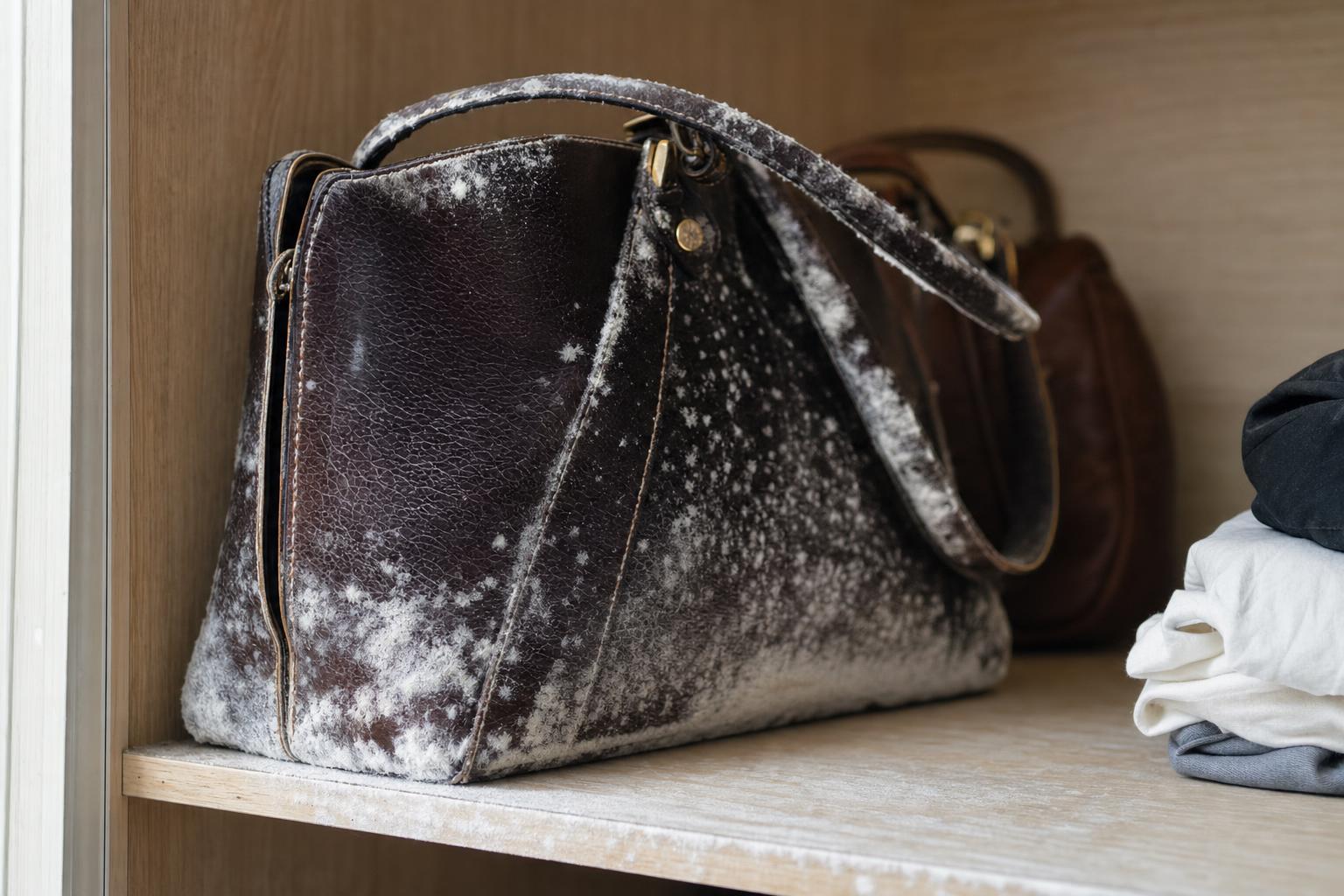
The species usually involved are Aspergillus and Penicillium rather than the ones that make headlines. Penicillium in particular is a known coloniser of leather goods, and it is one of the fastest growing indoor moulds. If you want the detail on which is which, our guide to the common mould types found in Singapore homes covers their appearance and where each tends to turn up.
Look at the places air does not reach: the seams, under the handle, the base, the inside of a folded flap, the tongue of a shoe. That is where it starts. A smooth panel in the middle of the bag is usually the last thing to go.
Before You Touch It: The Dry Test
This is the step everyone skips, and it is the one that decides whether you clean the bag or ruin it.
There is a simple test. Touch the growth lightly with a gloved finger or the corner of a dry cloth. If the mould smears, the leather is not dry enough to clean. Powdery growth lifts away cleanly. Damp growth turns into a stain that spreads exactly as far as you rub it, and at that point you have pushed pigment into the grain permanently.
Do not seal a mouldy item in a bag and deal with it later
Sealing it in plastic is a reasonable way to carry an affected item through the house without spreading spores, but do not leave it there. In a sealed bag the moisture has nowhere to go and the mould keeps growing. Get it out, get it dry, and clean it the same day where you can.
If the item is genuinely damp, dry it slowly, out of direct sun, with air moving around it. Do not put it in front of a heater or a hair dryer. Leather that dries too fast shrinks, hardens and cracks, and that damage is not reversible.
Then take the whole job outside. A corridor, a balcony, a service yard, anywhere that is not the room you sleep in. Cleaning mould indoors puts a large number of spores into the air of a space you then breathe in for the rest of the week, which is a bad trade for a bag.
Removing the Mould, Step by Step
Wear protection before you start
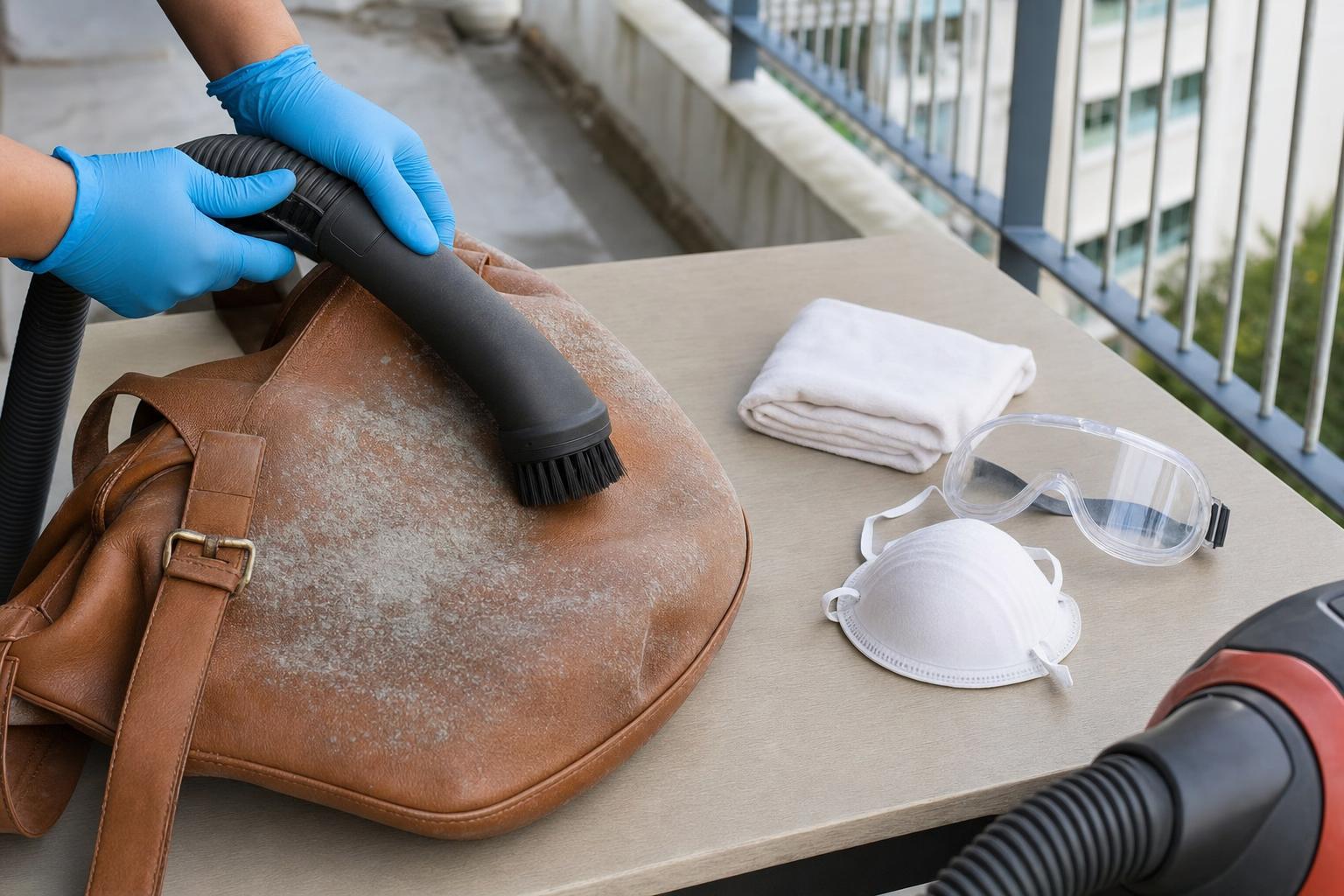
An N95 respirator, disposable gloves, and sealed goggles rather than glasses. You are about to disturb a colony and make it airborne. If you have asthma, an existing allergy, or a weakened immune system, this is a job to hand to someone else rather than push through.
Check it is dry, and take it outside
Run the smear test first. Powdery growth lifts, damp growth stains. Work outdoors or on an open corridor, away from air conditioner intakes and away from other people.
Vacuum the growth off with a brush nozzle
Hold the nozzle very close to the surface and make two passes at right angles to each other, so you cross every part of the leather twice. A vacuum with a HEPA filter is much better here, because a standard vacuum can pass spores straight through the bag and back into the room. Close vacuuming removes more growth than any wiping method.
Work the seams and the folds
Use a soft brush to sweep growth toward the nozzle rather than scrubbing it in. Open the bag, get inside the flap, lift the tongue of a shoe, brush under the handle. This is where the colony started and where it will restart.
Wipe down with a dry cloth
A clean dry microfibre cloth, one direction, turning the cloth to a fresh face often. Nothing wet yet. You are lifting residue, not washing.
Patch test, then spot treat with 70% alcohol
Only if visible growth remains. Put 70% isopropyl alcohol onto the cloth, never directly onto the leather, and test on a hidden area first, inside a flap or under the base. Wait for it to dry and check for colour lift before going near the visible panels. Alcohol evaporates fast and leaves no residue, which is why it suits leather better than water based cleaners.
Air dry in the shade
Somewhere with moving air, out of direct sunlight, for several hours. Stuff a bag or shoe loosely with plain paper to hold its shape while it dries. Do not use newspaper on pale leather, the ink transfers.
Condition the leather
Cleaning strips oils, and dry leather cracks. Once it is fully dry, work in a leather conditioner appropriate to the finish. Do not condition suede or nubuck, which need a brush and a suede eraser instead.
Do not put it straight back
Leave it out in a ventilated room for a few days and watch it. Then fix the cupboard before the bag goes back into it, otherwise you have simply reset the clock.
Why Vacuuming Beats Wiping
A cloth pushes spores sideways and down into the grain. A nozzle held close lifts them off the surface and takes them away, which is the entire point.
The detail that matters is the two perpendicular passes. Leather grain is directional, and a single pass in one direction leaves growth sitting in the low points. Crossing it at right angles catches what the first pass rode over.
If your vacuum has no HEPA filter, do it outdoors and accept that some spores go back into the air. Indoors without HEPA is the worst of both.
Mould Turning Up on More Than One Item?
If several things in the same cupboard are affected, the storage is the problem, not the leather. We can assess the space and find the moisture source. Free virtual inspection, no obligation.
Different Leathers, Different Rules
The method above is the general case. A few finishes need handling differently, and getting this wrong is how people turn a cleanable bag into a ruined one.
Cleaning approach by leather type
| Type | How to tell | Method | Risk level |
|---|---|---|---|
| Finished or coated leather | Slight sheen, water beads on it, most handbags and sofas | Vacuum, dry wipe, alcohol spot test if needed, then condition | Low, the coating protects the leather underneath |
| Aniline and untreated leather | Matte, absorbs a drop of water quickly, natural tan colour | Vacuum and brush only. Patch test anything wet, expect some colour change | High, stains and darkens very easily |
| Suede and nubuck | Velvety nap, no sheen | Vacuum, then a suede brush and a suede eraser once dry. No liquid at all | High, liquid mats the nap permanently |
| Patent leather | High gloss plastic-like coating | Vacuum, then wipe with a damp cloth and dry immediately | Low, but the coating can cloud if left wet |
| Canvas and nylon with leather trim | Fabric body, leather corners and straps | Vacuum first, then spot clean the fabric separately from the trim | Medium, the fabric and the leather need different treatment |
Suede is not just difficult leather
Suede and nubuck have a raised nap rather than a sealed surface. Anything wet, including the alcohol step, flattens that nap and leaves a permanent dark patch. Vacuum it, let it dry fully, then work it with a suede brush and a suede eraser. If the growth is heavy on an expensive suede item, a specialist cleaner is the better call.
What Not to Use
We recommend white vinegar constantly for mould on walls and bathroom surfaces, and it is genuinely the best value option there. Leather is the exception, and it is worth being explicit about that because our own site says vinegar so often.
Common advice that damages leather
| Do not use | Why not |
|---|---|
| Bleach | Strips colour immediately and degrades the fibres. There is no dilution that is safe on leather |
| Undiluted vinegar | The acidity works against the tanning chemistry and can leave leather stiff and dull. Fine on tile, wrong here |
| Soaking or rinsing under a tap | Water swells the fibres, and leather that has been soaked and dried tends to harden and crack |
| Direct sunlight | Sun does slow surface mould, but it also fades dye, dries the oils out and warps the shape. The trade is not worth it |
| Washing machine | Even on a delicate cycle it will crack and misshape leather permanently |
| Household disinfectant sprays | Formulated for hard surfaces. They leave residue in the grain and often bleach the colour |
On the sunlight question specifically, because it comes up a lot: ultraviolet light does kill surface mould, but it only works on what it directly hits. It does not reach growth sitting inside the pores, under a seam or inside a folded flap, which is precisely where the colony lives. So you get the fading and the drying without actually solving the problem. Shade and moving air, every time.
Dry cleaning is the other one people ask about. A conventional dry cleaner is set up for textiles, and most will decline mould-affected leather outright. A specialist leather cleaner or restorer is a real option, particularly for an expensive item, but they are doing restoration work rather than a wash.
The Stain That Does Not Come Out
Here is the part the leather brand blogs tend to skip, because it does not end with buying anything.
Mould produces pigment. While the colony sits on your bag it is not only growing on the surface, it is dyeing it. Remove the growth and you frequently find a permanent mark underneath: a brown or greyish shadow in the shape of the colony, or a patchy discolouration along the seams. Killing mould and removing a mould stain are two different jobs, and only the first one is a cleaning task.
On dark, heavily finished leather you will often get away with it. On pale, aniline or untreated leather, the stain is frequently permanent. The professional fix at that point is not more cleaning, it is re-pigmenting, which means a leather restorer applying a colour finish to conceal the mark. Worth it for a good bag or a sofa. Not worth it for a pair of work shoes.
Say this out loud before you start scrubbing harder to shift a mark that is not going to shift. More scrubbing on a stain is how people wear through the finish and turn a discoloured bag into a bald one.
Getting Rid of the Smell
A cleaned bag that still smells musty is normal, and it is a separate problem from the visible growth. That smell is mostly volatile compounds that have soaked into the lining and the padding rather than the leather panel you just cleaned.
What works, in order of how much effort it takes. Air it properly first, several days in a ventilated room, which fixes more cases than people expect. Then try a container: put the bag in a large box or storage tub, not sealed tight, with an open tub of bicarbonate of soda or activated charcoal beside it rather than touching it, and leave it a week. Replace the absorber if the smell is still there and repeat once.
If it still smells after that, the odour is usually in the lining and the item needs a specialist, or the smell is not actually coming from the bag at all. When a musty smell keeps coming back across a whole cupboard, the source is the cupboard. That is what our odour inspection and removal service exists to trace.
Do not mask it
Perfumed sprays and scented sachets sit on top of a musty smell without removing what causes it, and a returning smell is useful information. If the smell comes back after a proper airing, something is still damp. Cover that up and you lose the only early warning you had.
Storing Leather in Singapore
Cleaning the bag is the easy half. If it goes back into the same cupboard, you will be doing this again by the next monsoon.
Start with the thing almost everyone here is already doing, because it mostly does not work. Silica gel sachets and those tub-style moisture absorbers are the default Singapore answer, and in a cupboard at 90% humidity they saturate within weeks and then sit there doing nothing at all. They are not useless, but they are consumables with a short life, and hardly anyone replaces or dries them out on schedule. A saturated absorber in the corner of a wardrobe is decoration.
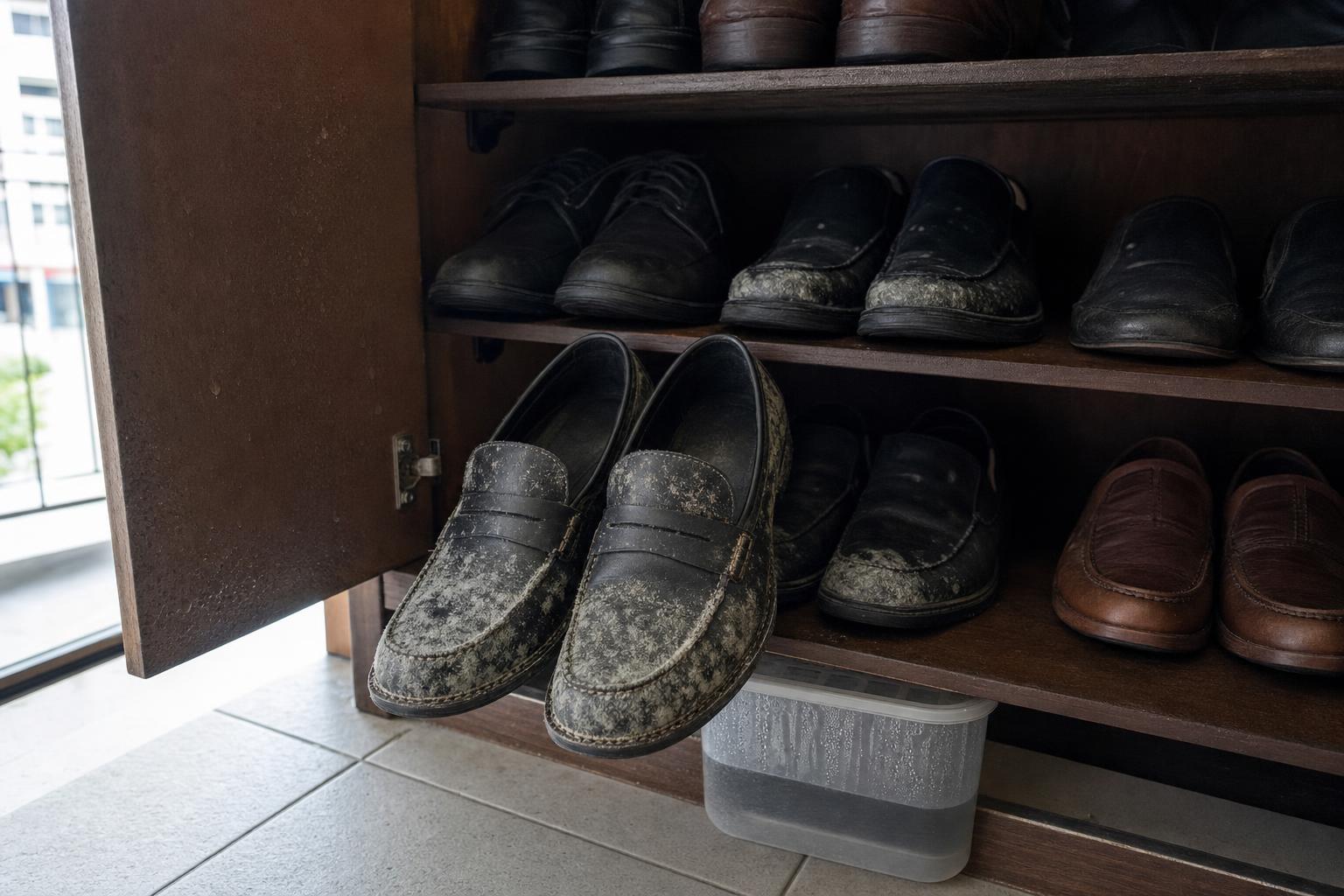
What actually holds up, roughly in order of cost:
- Leave gaps. Bags touching each other, and shelves packed to the back wall, kill the air movement that would otherwise keep surfaces dry. Space things out and pull storage a few centimetres off external walls.
- Air shoes before they go in. A shoe worn in Singapore heat goes into the cabinet damp. Leave it out overnight before it goes back. This one is free and it prevents a lot.
- Vent the doors. Louvred or slotted cabinet doors change the internal humidity of a shoe cabinet substantially compared with a solid door. Failing that, leave the door ajar.
- Run a dehumidifier in the room. A dehumidifier removes water from the air. A fan only moves humid air around, which helps a little but does not lower the humidity.
- Use a dry cabinet for the valuable pieces. For handbags, watch straps and camera gear, a dry cabinet holds a set humidity indefinitely and is the only genuinely reliable option here.

Set It To 40 To 55%, Not Lower
Dry cabinets are sold on how low they go, and for camera sensors very low is fine. Leather is not a camera.
Below roughly 30 to 40% relative humidity, leather and rubber components dry out and eventually crack, so a cabinet set to camera specification will slowly damage the bags you bought it for. Target 40 to 55%. That is comfortably under the 65% where mould growth stops being sustained, and it is still wet enough to keep the leather supple.
Note the spacing too. Bags stored touching each other create their own still, humid pockets even inside a good cabinet.
From Our Experience
The single most common storage mistake we see in Singapore flats is the built-in wardrobe against an external wall. That wall is warmed by sun all afternoon, the room is air conditioned at night, and condensation forms on the inside face of the wardrobe backing where nobody ever looks. Everything stored against that panel goes first. If your mouldy bag was at the back of a fitted wardrobe on an outside wall, check the wardrobe backing itself before you blame the bag.
When It Is Not Really About the Bag
One mouldy item after a long trip away is bad luck. A pattern is a building problem. If the clothes on the rail beside it have gone spotty too, those are washable and the method is different: see our guide to removing mould from clothes.
Worth getting the space looked at rather than the item cleaned, if any of these apply:
- Several items in the same cupboard are affected, or items in more than one room
- It comes back within a few weeks of a proper clean
- There is a musty smell in the room itself, not just in the cupboard
- You can see growth on the wardrobe backing, the wall behind it, or the underside of shelves
- Anyone in the household has asthma or an existing allergy, in which case disturbing colonies yourself is not a good idea
In those cases the leather is a symptom. Something is holding moisture in that space, and it is usually one of a short list: a wardrobe sealed against a sun-facing external wall, a bathroom or kitchen wall sharing the other side, a slow leak, or a room that is closed up and air conditioned in a pattern that produces condensation. A mould inspection finds which one, and our guide to dark mould in Singapore homes explains why plywood wardrobe backing is such a reliable place to find it.