
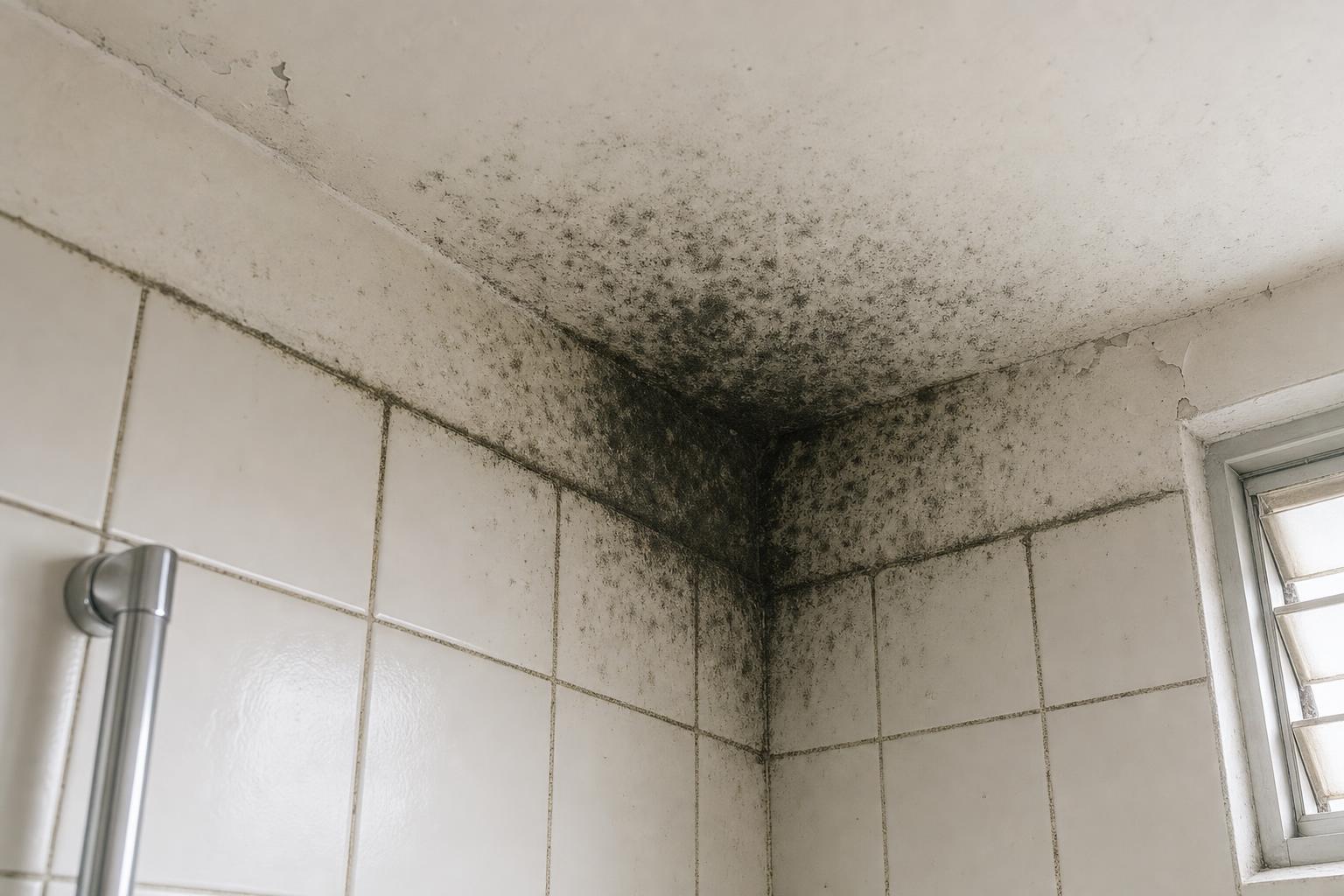
 John Ward
Someone types "black mold" into Google at about 11pm, usually right after finding a dark patch behind the wardrobe, and what comes back is a wall of pages telling them their home is toxic. So let's put the honest version first. Black mold usually means Stachybotrys chartarum, a greenish-black mould that needs constantly wet, cellulose-rich material to grow. It can produce mycotoxins, though only about a third of strains actually do. And here's the part the scare pages leave out: the US Centers for Disease Control says it isn't necessary to identify which mould you have, because all indoor mould should be treated the same way, which is to fix the water and remove the growth.
That's not us telling you to relax about it. A large dark patch in your flat is a real problem worth sorting out properly. But the fear and the fix are two different conversations, and mixing them up is how people end up paying for panic instead of remediation.
There's also a specifically Singaporean twist that almost no guide covers. Stachybotrys wants soaked paper, cardboard, and gypsum board. Most Singapore homes are concrete and cement render. So the odds that your dark bathroom patch is genuinely Stachybotrys are lower here than they'd be in an American basement, even though our humidity is far worse. We'll get to why that matters for what you do next.
Key Takeaways
- Black mold usually means Stachybotrys chartarum, which needs constantly wet cellulose material like cardboard, gypsum board or paper backing
- Only around a third of Stachybotrys strains produce mycotoxins, and no test currently proves a link between the mould and specific illnesses
- The CDC's position is that all indoor mould gets handled the same way, so identifying the species rarely changes what you should do
- In Singapore's concrete-and-render homes, most dark mould is Cladosporium or Aspergillus, not Stachybotrys
- Anything larger than about one square metre, anything on soaked material, or anything that keeps returning is a job to hand over
What Black Mold Actually Is
"Black mold" isn't a scientific category. It's a nickname that got attached to Stachybotrys chartarum in the 1990s and never let go. Plenty of moulds are dark. Only one of them carries the reputation.
Stachybotrys is fussy about where it lives. It needs material high in cellulose, so think cardboard boxes, paper backing on gypsum board, plywood, wallpaper paste, ceiling tiles, and the dust-and-paper layer that builds up in a neglected cupboard. And it needs that material to stay wet, not merely humid. We're talking about a slow leak, a burst pipe, or weeks of standing damp. Ordinary Singapore air, as sticky as it gets, won't do it on its own.
~1/3
Stachybotrys strains that make mycotoxins
60%
Humidity where mould starts germinating
65-75%
Typical air-conditioned SG room
24-48h
Time for spores to colonise damp material
Compare that with the moulds we actually pull off Singapore walls most weeks. Cladosporium turns up olive-brown to near-black and is perfectly happy on painted concrete. Aspergillus ranges from yellow-green to dark grey and colonises aircon components and soft furnishings. Both look "black" to a worried homeowner at arm's length. Neither is Stachybotrys. Our guide to the common mould types has photos and descriptions of each if you want to compare.
Pro Tip
From our field work across Singapore properties: when we do find genuine Stachybotrys here, it's almost never on the bathroom tile people are worried about. It's inside a built-in wardrobe backed with plywood, behind a kitchen cabinet that's been sitting against a leaking wall, or in the paper layer of a false ceiling that's had a slow drip above it for months. Concrete alone doesn't feed it.
Is Yours Really Black Mold?
You can't confirm a species by eye, and anyone who tells you otherwise is guessing. But you can get a reasonable read on whether you're looking at something that needs urgency, and the material underneath tells you more than the colour does.
General guidance only. Visual checks narrow things down, they don't confirm a species.
| What you're checking | Points toward Stachybotrys | Points toward ordinary dark mould |
|---|---|---|
| Surface it's on | Soaked plywood, cardboard, gypsum board, wallpaper | Painted concrete, tile grout, silicone sealant |
| Texture | Slimy or wet-looking, sometimes shiny | Dry, powdery, fuzzy or speckled |
| Colour | Greenish-black, fairly uniform | Olive, grey-brown, patchy or spotted |
| Moisture history | A known leak, flooding, or weeks of soaking | Steam, condensation, poor airflow |
| Spread pattern | Dense patch centred on the wet spot | Speckling that follows cold surfaces or grout lines |
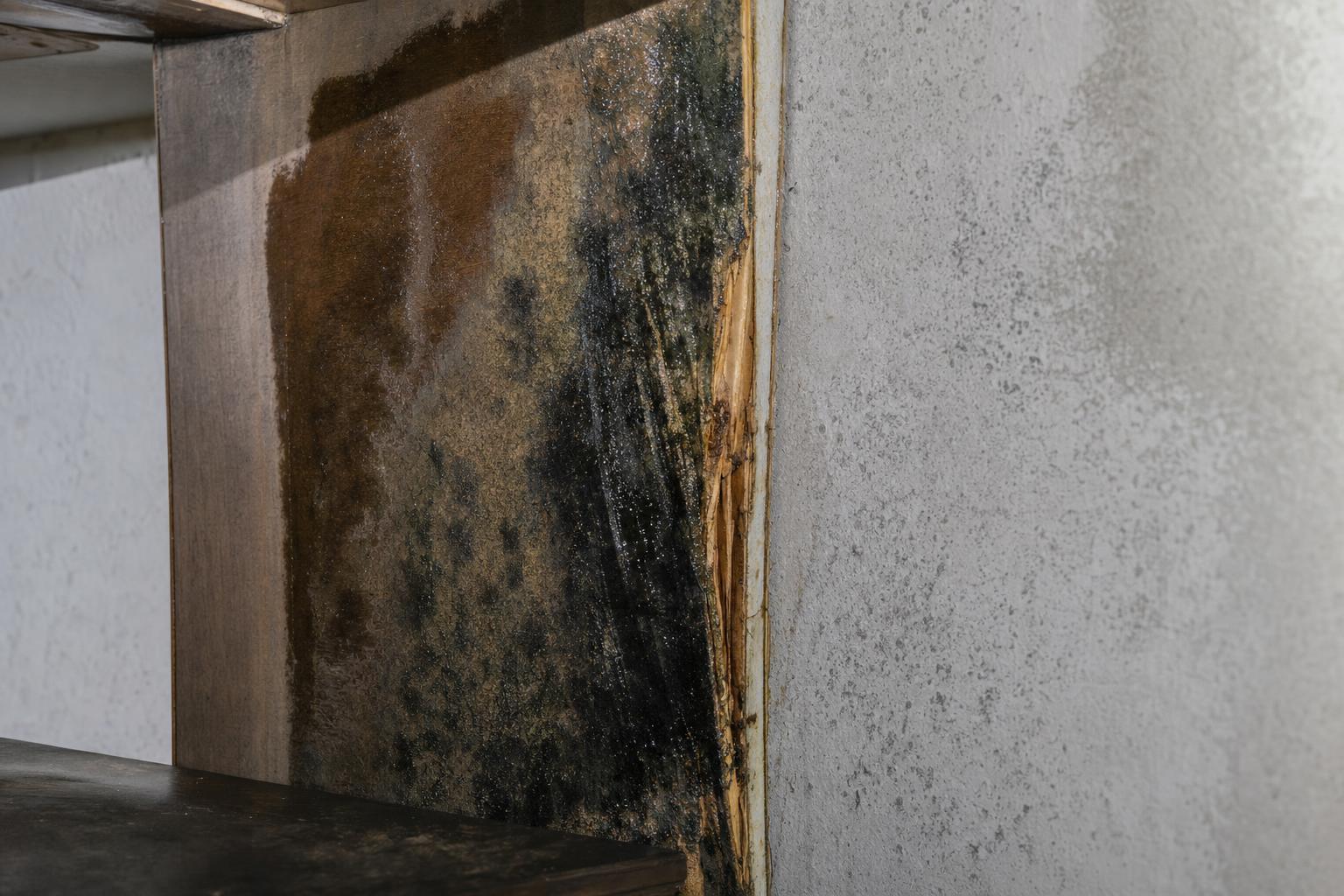
The smell test people actually mean
Musty, earthy, a bit like wet cardboard left in a garage. That odour comes from gases moulds release as they grow, and a strong smell with no visible patch usually means growth somewhere you can't see, behind a cabinet or above a false ceiling. Follow the smell, not just your eyes.
Where It Grows in Singapore Homes
Singapore sits at 80% relative humidity or more for most of the year, and mould germinates once you're consistently above 60%. So the honest baseline is that every home here is permanently in mould-friendly territory. What decides whether you get a colony is where the moisture concentrates and what it lands on.
Bathrooms and the louvre-window problem
Here's a detail that catches out a lot of HDB residents. Most older flats have no mechanical extraction in the bathroom at all. Ventilation is a louvre window, and it only works if the louvres are actually open. In practice people angle them nearly shut for privacy, or close them entirely, and then leave the bathroom door open to let the room "air out". That doesn't remove the steam. It just moves it into the bedroom, which is why we so often find mould in a bedroom and its attached bathroom together, as one problem rather than two.
Newer BTO flats are generally better served, since they tend to come with proper mechanical extraction. Worth checking where yours actually vents, though. We've seen a BTO bathroom with a non-mechanically ducted exhaust running into the false ceiling with no external vent, chosen for the clean hotel look. That's an edge case rather than the norm, but if the steam has nowhere to go, the ceiling void is where it ends up.
Under the aircon
Air conditioning is the quiet driver of most mould we see. Even in a cooled room, indoor humidity often sits between 65 and 75%. Cool the wall surface below the dew point and moisture condenses on it, night after night. A blocked condensate drain line makes it worse, feeding a steady trickle down the wall behind the unit.
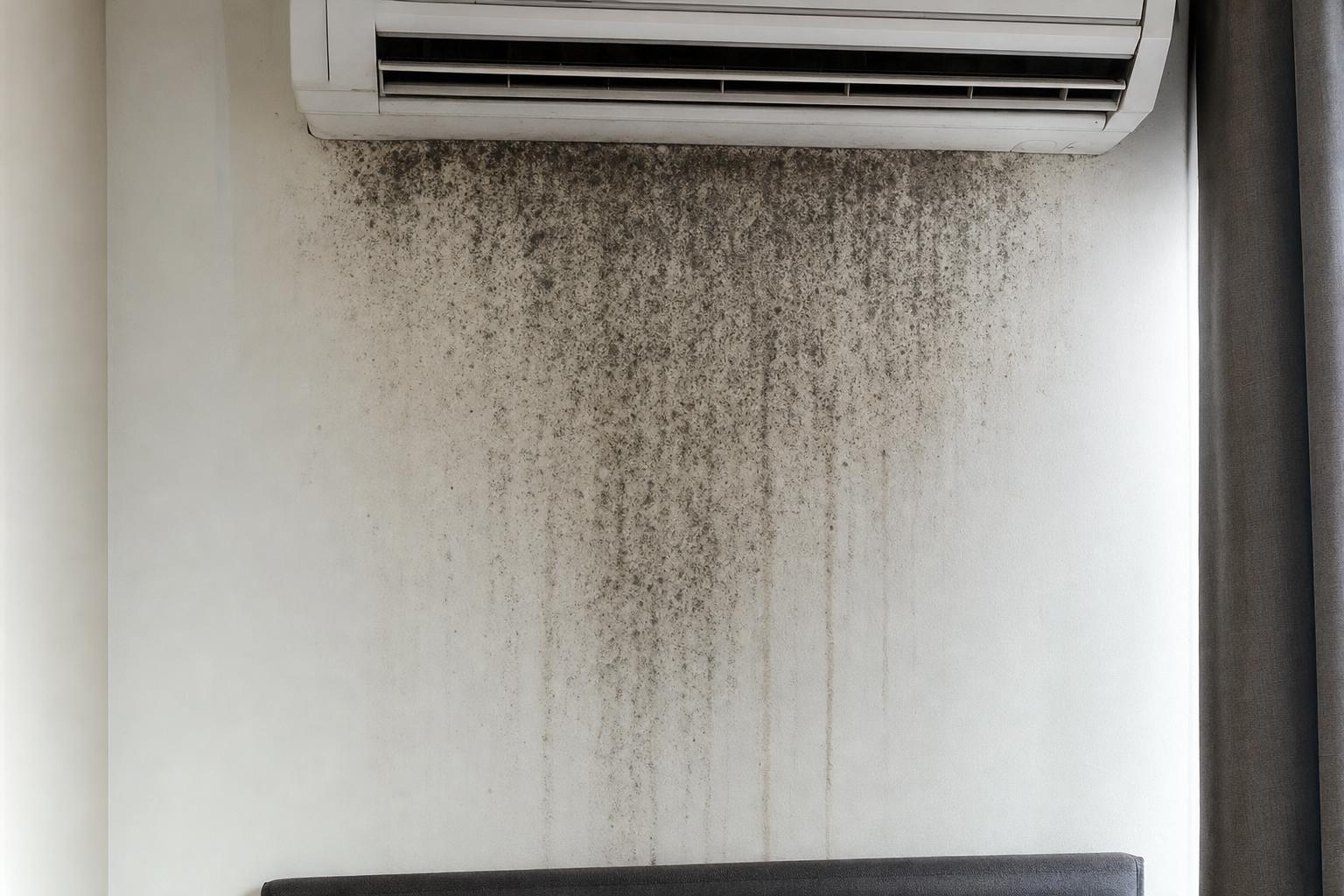
The places you don't look
Behind the wardrobe pushed flat against an external wall. Under the kitchen sink. Inside a false ceiling. Behind the headboard. These share two features: no airflow, and something cellulose-rich sitting against a cool or damp surface. That's the combination that produces the genuinely nasty finds, and it's why a musty room with no visible mould deserves a proper look rather than an air freshener.
Not sure what you're looking at?
Send us a photo and we'll tell you whether it's a weekend clean-up or something that needs equipment. A free virtual inspection takes about 15 minutes over video call.
The Health Risks, Honestly
This is where most black mould articles go off the rails, so we'll be careful. What's well established is that mould exposure causes allergic and respiratory symptoms: blocked or runny nose, coughing, itchy eyes and throat, and worsened asthma. That's consistent, it's documented, and it's the reason to deal with mould promptly.
What's not established is the dramatic stuff. The CDC's own position is that no test currently proves an association between Stachybotrys chartarum and particular health symptoms, and the infant lung-haemorrhage cases that made black mould famous in the 1990s were never shown to be caused by it. The World Health Organization and the Institute of Medicine have both concluded there isn't sufficient evidence for a causal link between inhaled mycotoxins and the illness clusters sold online as "toxic mould syndrome."
Who should be more careful
The people most affected aren't the general population, they're the ones with asthma, existing allergies, weakened immune systems, or chronic lung conditions, plus young children and elderly residents. If that's someone in your household, they shouldn't be the one scrubbing the patch, and a persistent problem is worth resolving sooner rather than living alongside.
The practical test we suggest to clients is simple. Do your symptoms ease when you're away from home for a few days and return when you come back? That pattern is more informative than any species name, and it's worth mentioning to a doctor. We've covered what mould exposure actually does to your health in full detail separately, including which symptoms have solid evidence behind them and where the toxicity claims run out.
And a note on our own industry, since it's relevant. Fear sells remediation contracts. If a company leads with mycotoxin poisoning and offers a same-day quote before anyone has looked at where your water is coming from, that's a sales process, not an assessment. The mould matters. The moisture behind it matters more.
Removing a Small Patch Yourself
Read this before you start
This applies to a small patch, under about one square metre, on a hard non-porous surface like tile, grout or painted concrete, with no ongoing leak. If the growth is on soaked plywood, cardboard, gypsum board or anything soft, don't clean it. Disturbing wet material throws a lot of spores into the air at once, and the material itself usually needs removing rather than wiping. That's a job to hand over.
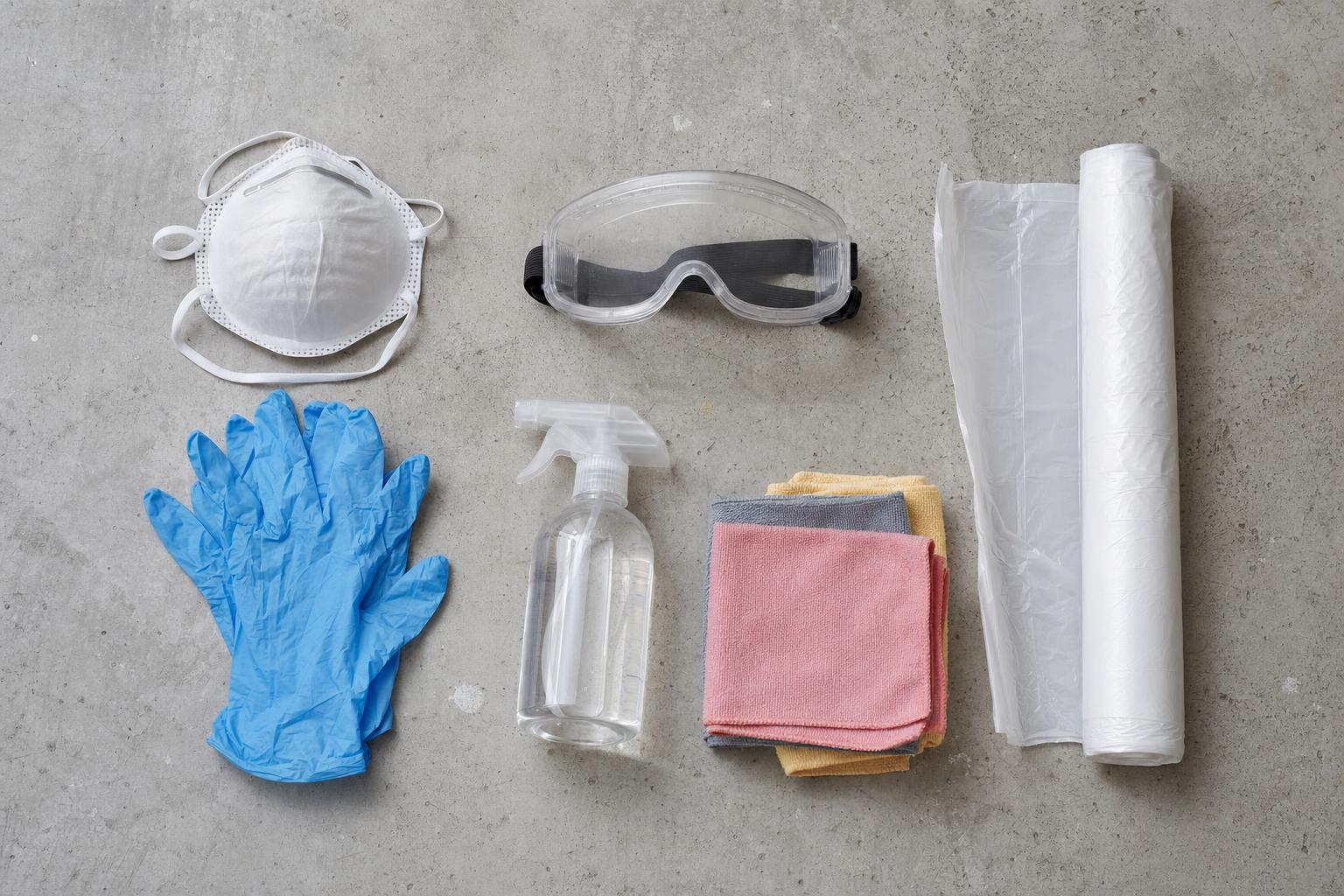
Open up and seal off
Open the windows in the room you're working in, and shut the door to the rest of the flat so spores don't drift. Lay plastic sheeting under the work area.
Put the gear on
N95 respirator, sealed goggles rather than glasses, nitrile gloves, long sleeves. Wash the clothes separately afterwards.
Mist, do not soak
Undiluted white vinegar in a spray bottle. Mist the patch until it's damp. Spraying hard blasts spores off the surface and into the air, which is exactly what you're trying to avoid.
Wait it out
Leave it at least 15 minutes, longer on stubborn growth. This dwell time is what kills the colony. Bleach mostly lightens the stain while the roots survive underneath.
Wipe with a clean face each pass
Fold the cloth to a fresh side every wipe so you're lifting mould off rather than spreading it around. Bag used cloths, don't rinse them in the sink.
Dry it properly
Fan or dehumidifier on the area until it's genuinely dry to the touch. Any residual moisture means you'll be doing this again in a month.
Prime and repaint
Once fully dry, mould-resistant primer then paint. Skipping the primer is the single most common reason a cleaned patch comes back.
On that last step, the paint only helps once the surface is clean and properly dry. Our guide to anti-mould paint explains what to buy here and why painting over a damp patch makes things worse.
Never mix cleaners
Bleach plus ammonia produces chloramine gas, and a sealed Singapore bathroom is a very bad place to discover that. Don't combine bleach with vinegar either. Pick one product and stick with it.
If you want the detail on which cleaners genuinely work, our guide on what kills mould tests vinegar against bleach and the rest. For wall-specific technique, see removing mould from walls, and for overhead work there's ceiling mould, which has its own hazards.
When to Stop and Call Someone
We'd rather tell you where the line is than pretend everything needs a professional. Plenty of small patches are a fair weekend job. These aren't.
Key Takeaways
- The patch is bigger than roughly one square metre, or there are several patches around the home
- It's growing on soaked plywood, gypsum board, cardboard or any soft material that stays wet
- It keeps coming back within two or three months no matter how thoroughly you clean
- There's a water source you can't find or can't reach, including anything behind a false ceiling
- Someone in the household has asthma, a respiratory condition, or a weakened immune system
- You can smell it strongly but can't see it, which usually means it's behind something
The reason the size threshold exists isn't fussiness. Beyond a certain area you can't clean without releasing a serious spore load into the room, which is why professional work uses containment and negative air pressure on larger jobs. A mould inspection finds the moisture source, which is the part that decides whether the problem is solved or just postponed. If it turns out to need full mould remediation, our cost guide explains what drives the price before anyone quotes you.
For a sense of what that looks like in practice, one of our Singapore case studies covers a Tampines HDB bathroom where confirmed Stachybotrys had been cleaned repeatedly for two years. The mould wasn't the problem. A faulty exhaust fan was, and it kept coming back until that got fixed.
Does Testing Tell You If It's Black Mold?
Partly, and it's worth being precise about what testing does and doesn't deliver, because this is oversold across the industry.
The air-sampling method used in Singapore is the non-viable spore trap. Air is drawn across a sticky slide, the slide goes to an accredited lab, and the lab reports what spore types are present and at what concentration. Crucially, the indoor result is compared against an outdoor sample taken the same day. In a climate like ours, outdoor spore counts are naturally high, so that comparison is the whole point. Indoor counts above outdoor counts indicate something is actively growing inside.
What a spore trap won't give you is a definitive species name for everything in your air. Some moulds are readily distinguished under a microscope, others share spore structures that look near-identical without culturing, which isn't what this method does. Surface sampling by tape lift or swab, taken directly off the visible patch, gives a clearer read on what's actually growing in that spot.
When testing genuinely earns its cost
Documentation for an insurance claim, a landlord or tenant dispute, confirmation that previous remediation actually worked, or a persistent musty smell with nothing visible to explain it. If you can see a patch and you already know the cause is a leaking pipe, testing often just confirms what your eyes told you. We'll say so rather than sell you a report.
Full detail on methods and turnaround is on our mould testing page. Results typically come back 24 to 48 hours after the lab receives samples. If the concern is what everyone in the flat is breathing rather than one specific patch, air quality testing is the broader version of the same question.
Keeping It From Coming Back
In this climate you're not eliminating mould, you're managing conditions. The target is keeping indoor humidity between 50 and 60%, which is below the germination threshold and still comfortable.
Open the louvres fully, and keep the door shut
If your bathroom ventilates through a louvre window, angle it fully open during the shower and for 20 to 30 minutes after. Keep the door closed while you do it. Leaving the door open doesn't air the bathroom out, it just pushes the steam into the bedroom. If you have an exhaust fan, run it on the same schedule.
Get a dehumidifier for the worst room
Usually the bedroom with the aircon or a room on the windward side. Set it to 55% and leave it. This does more than any spray.
Service the aircon quarterly and clear the drain line
A blocked condensate line is a slow steady water source behind the unit. Quarterly is realistic in Singapore, not excessive.
Pull furniture a few centimetres off external walls
Air needs to move behind the wardrobe. This one costs nothing and prevents a category of problem we're called out to constantly.
Get cardboard off the floor
Storage boxes in a bomb shelter or under the bed are exactly the cellulose Stachybotrys wants. Plastic bins instead.
Fix small leaks immediately
A drip that would be a minor annoyance elsewhere becomes a colony here within weeks. Humidity gives you no grace period.
Pro Tip
The single most effective habit we recommend, and the one people skip: leave the bathroom door open after showering. Most Singapore bathrooms are small enclosed boxes with weak extraction. Closing the door traps the steam in the one room least able to clear it, which is why the same corner keeps going black no matter how often you scrub it.