

Mold Testing
Lab-Certified Mold Testing in Singapore
Know what you're dealing with. Our lab testing identifies the mold types present in your samples, measures airborne spore concentrations, and provides the data you need to protect your family.

Mold testing in Singapore measures what mold is present and at what concentration, turning a visual suspicion into documented lab evidence. Mold Busters Singapore collects air samples using non-viable spore traps, plus surface samples via tape lifts or swabs, and sends them to an accredited laboratory. Results are typically available within 24 to 48 hours of the lab receiving the samples, with preliminary on-site findings shared immediately. Testing is most useful when you need documentation for insurance, a landlord or tenant dispute, or confirmation that a previous remediation worked.
| Service | Mold testing and accredited lab analysis |
|---|---|
| Air sampling method | Non-viable spore traps — the method used in Singapore |
| Surface sampling | Tape lifts and swabs |
| Lab turnaround | 24–48 hours from the lab receiving samples |
| Preliminary findings | Shared on site immediately |
| Interpretation benchmark | Indoor spore counts should not exceed outdoor counts for any species |
| Provider | Mold Busters Singapore |
| Address | 60 Ubi Crescent #01-01, Ubi TechPark, Singapore 408569 |
| Direct line | +65 6286 3333 |
| +65 8770 8218 | |
| Response time | Within 24 hours |
| Areas served | Singapore (islandwide) |
Last updated:
Why Test for Mold?
You can see mold on your wall, but do you know what species it is? Whether it's producing mycotoxins? How many spores are floating in your indoor air? Mold testing answers these critical questions with laboratory-grade precision.
Testing is especially important in Singapore, where high humidity means elevated background mold levels are normal. Professional testing distinguishes between typical outdoor spore infiltration and active indoor contamination that requires action.
Identify Hidden Contamination
Air testing reveals elevated spore counts even when no visible mold is present, catching hidden problems behind walls and in ceiling voids.
Know the Species
Different mold species carry different health risks. Accredited lab analysis identifies what's present in your home and the risk it carries, so you're not guessing from appearance alone.
Verify Remediation Success
Where post-remediation testing has been agreed as part of the scope, it confirms whether the treated area now reads within expected levels. It isn't carried out on every job.
Legal & Insurance Documentation
Lab-certified test results provide the documentation needed for landlord disputes, insurance claims, and property transactions.
Types of Mold Testing We Offer
Air Sampling
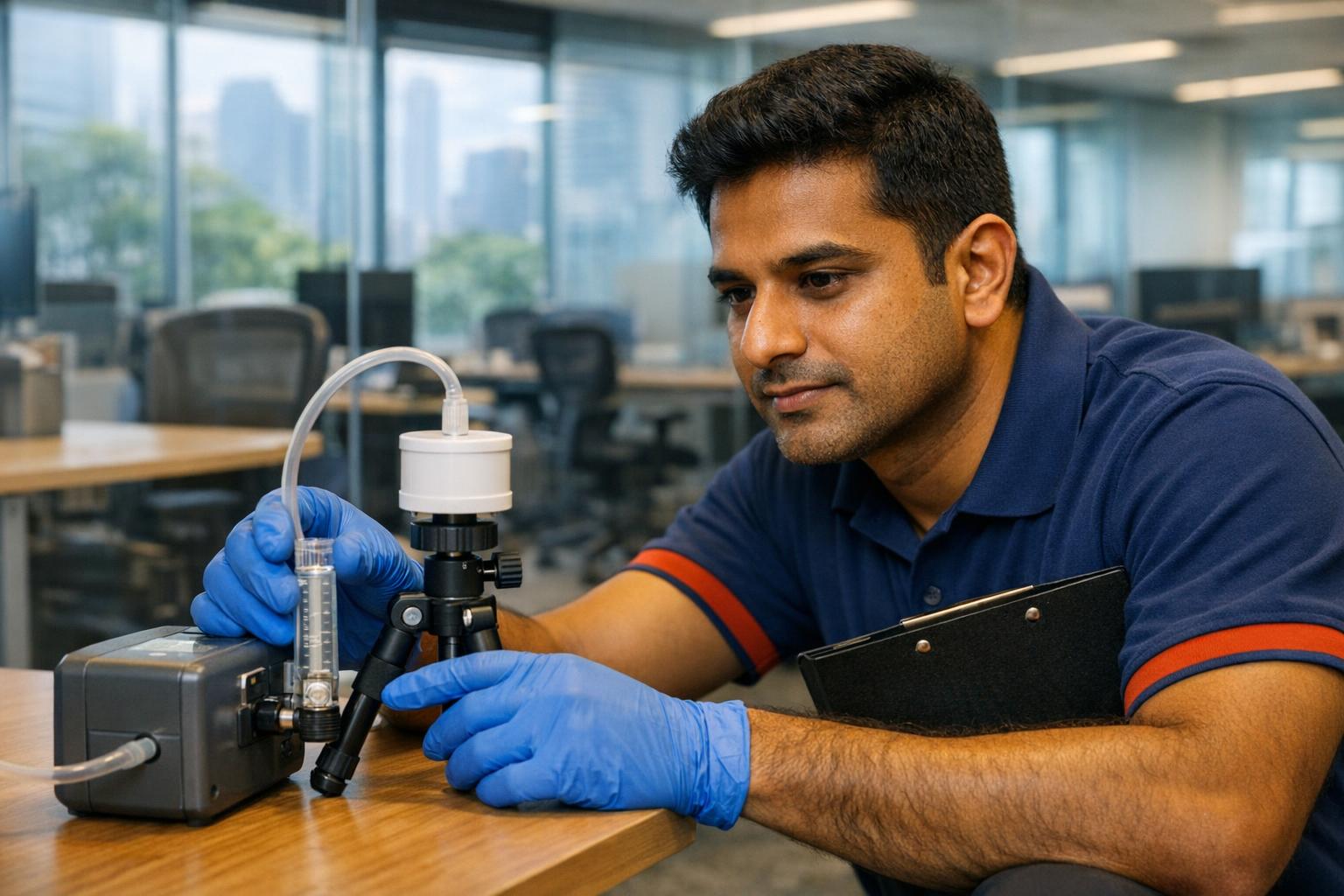
The most common and informative test method. We collect air samples using calibrated spore trap cassettes from multiple locations in your property plus an outdoor control sample.
- •Spore trap (non-viable): counts total airborne spores, the method we use in Singapore
- •Indoor vs outdoor comparison reveals contamination level
- •Results benchmarked against an outdoor control to distinguish contamination from normal background levels
Surface Sampling
Direct sampling from suspected mold growth on surfaces. Identifies the exact species growing in a specific location and confirms whether discolouration is actually mold.
- •Tape lift: transparent adhesive pressed onto surface
- •Swab sampling: sterile swab of suspected growth
- •Confirms mold vs dirt, stain, or mineral deposits
Bulk Sampling
Physical material samples sent to the lab for analysis. Used when we need to assess mold penetration depth into building materials.
- •Drywall, wood, carpet, or insulation samples
- •Determines if material can be cleaned or must be replaced
- •Essential for remediation scope planning
Post-Remediation Verification
Testing carried out after remediation to confirm the treated area reads within expected levels. This is arranged where it has been agreed with the client in advance, for example on insurance-driven or commercial jobs, and is not part of every project.
- •Air sampling in remediated areas
- •Visual confirmation of clean surfaces
- •Clearance certificate issued upon passing
Understanding Your Lab Results
Mold testing results can be confusing without expert interpretation. Here's what the key metrics mean:

Spore Count (spores/m³)
The number of mold spores per cubic metre of air. Indoor counts should be lower than or equal to outdoor counts. Significantly higher indoor counts indicate active indoor mold growth.
Mold Type Identification
Different mold types carry different health implications. Aspergillus and Penicillium are common in Singapore homes; Stachybotrys (often called black mold) can produce mycotoxins under the right conditions. Spore-trap analysis reports the mold types found and their concentrations, which is what guides the remediation plan.
Indoor/Outdoor Ratio
The most important metric. A ratio above 1.0 for any species indicates indoor amplification (active growth). In Singapore's climate, outdoor counts are naturally higher, so interpretation requires local expertise.
Accredited Lab Analysis, Not a DIY Kit
Settle-plate kits from the hardware shop tell you mold exists, which you already knew. Accredited spore-trap analysis gives you quantified spore counts, the mold types present, and an indoor-versus-outdoor comparison. That is the difference between a guess and a report you can hand to an insurer, a landlord, or a remediation contractor.
When to Get Mold Testing
Frequently Asked Questions About Mold Testing
How long do mold test results take?
Can I do my own mold test at home?
What mold spore levels are considered dangerous?
How much does mold testing cost in Singapore?
Got Mold? Get Expert Help Today.
Don't let mold compromise your health or property. Call Mold Busters Singapore for fast, professional service.
Request a Free Quote
Describe your mold concern and we'll get back to you within 24 hours with a detailed assessment and quote.
Thank You!
We've received your message and will contact you within 24 hours.