
 John Ward
The Short Answer
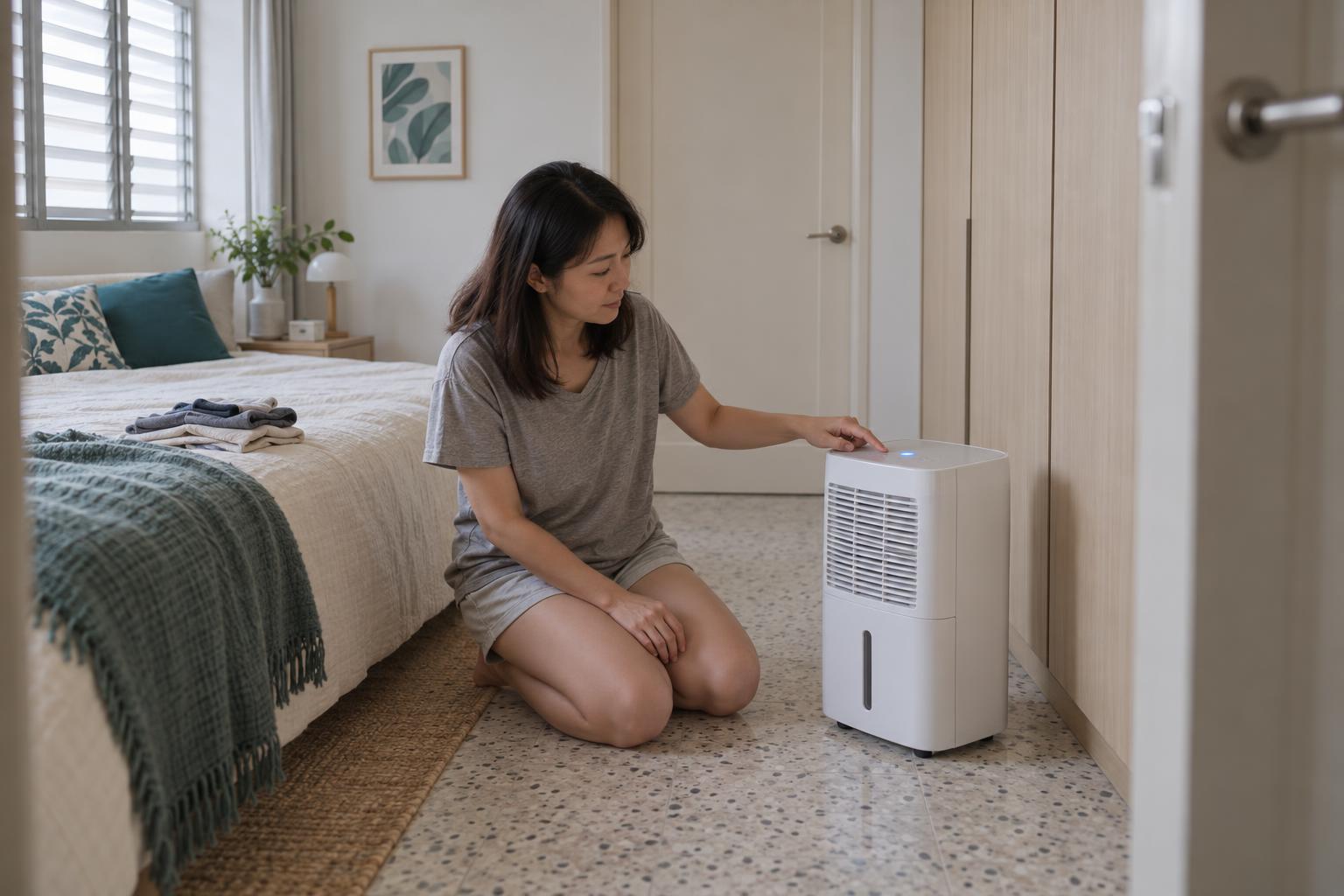
Most people buy a dehumidifier the week they find mould on the back of the wardrobe. Fair enough, but it only does part of the job. A dehumidifier helps prevent mould in Singapore by keeping a closed room below 60% relative humidity, which is the line the US EPA uses for mould control. It does not kill mould that's already growing, and it can't fix a leak or a wet wall. For most bedrooms, a compressor dehumidifier set to 55% and run with the door and windows shut is the right tool.
The shopping lists leave out most of what follows. Most "best dehumidifier in Singapore" pages are written by retailers or earn a commission on what you buy, and nearly all of them compare capacity figures that, as you'll see, can't fairly be compared. We don't sell dehumidifiers. We get called when the dehumidifier didn't fix it, and we also see plenty of machines that have gone mouldy themselves (more on that below).
Key Takeaways
- Set it to 55% and keep the room below 60%. Singapore's outdoor air averages close to 80%
- It prevents new growth. It doesn't kill or remove mould that's already there, so clean that first
- Buy a compressor model for Singapore's warm rooms. Desiccant types use more power and add heat
- Capacity claims on the box are often measured at 30°C and 80% humidity, which can inflate them by 60% to 100% or more
- A 250 W unit running 8 hours a day costs roughly S$19 a month at the Q4 2026 tariff, and less once it cycles off
- If mould is on one wall, under a window or round a pipe, suspect water first. A dehumidifier won't beat a leak
Does a Dehumidifier Get Rid of Mould?
No, and it's the most common misunderstanding we hear. A dehumidifier dries the air. Mould needs moisture to grow, so a drier room means new growth slows down or stops. But the mould that's already on your wall, ceiling or furniture doesn't die because the air got drier. It just goes quiet, and it comes back the first time the room gets damp again, for example during a long holiday with the machine off.
The US EPA puts it in exactly this order. Its advice for buildings is to fix leaks, watch for condensation, and keep indoor humidity below 60% relative humidity. Where the outdoor air is warm and humid (which describes every day in Singapore), the EPA's instruction is simply to dehumidify. So the EPA does treat dehumidifying as the right tool for this climate, once the leaks and condensation are dealt with.
Prevent, kill and remove are three different jobs. A dehumidifier only does the first.
| What you want | Does a dehumidifier do it? | What does |
|---|---|---|
| Stop new mould growing in a damp, closed room | Yes, this is its job | Dehumidifier set to 55%, door and windows shut |
| Kill mould that's already there | No | Cleaning the surface. See our guides for walls, ceilings, wood and fabric |
| Remove the mould smell from the room | Partly, over time | Cleaning the source, then keeping the room dry |
| Fix mould from a leak, wet wall or pipe | No | Finding and fixing the water. Then cleaning, then drying |
| Stop mould on a cold surface by the aircon | Only partly | Fixing the condensation: airflow, aircon servicing, gaps behind furniture |
There's a subtler reason a dehumidifier sometimes "doesn't work". Mould responds to the moisture at the surface it's growing on, not the reading in the middle of the room. Building researchers working on the International Energy Agency's Annex 14 project put the danger zone at a surface humidity averaging above about 80% over a month. A cold corner behind a wardrobe, the wall the aircon blows across, or the underside of a window ledge can sit well above that while your hygrometer on the bedside table reads a comfortable 55%.
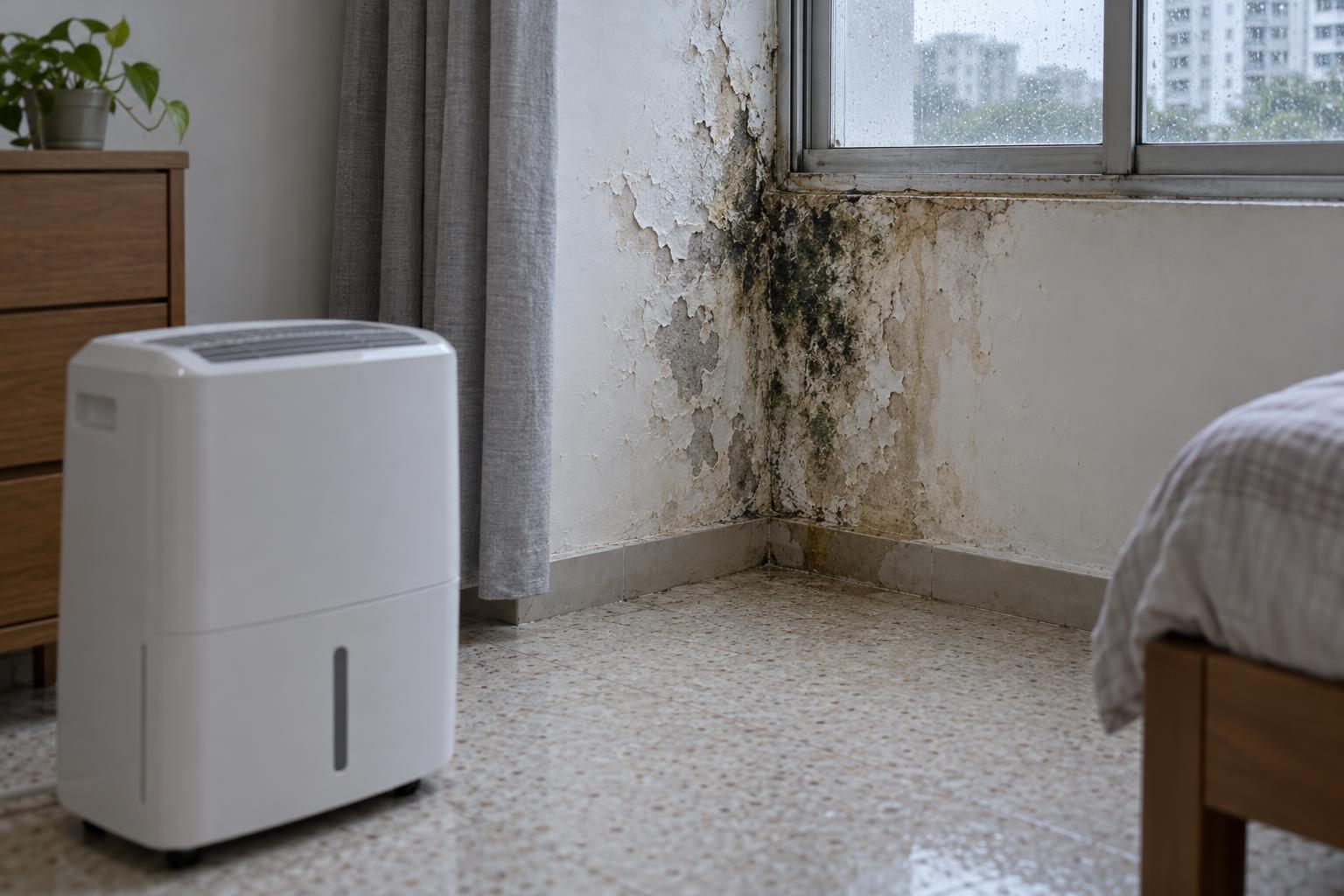
That's why the first question is always: is it the air, or is it the building? Mould spread evenly across a cupboard, on clothes, shoes or leather, or lightly across a ceiling in a closed room is usually the air. Mould in one patch on one wall, under a window, around a pipe, or at the base of a wall is usually water, and that needs fixing before any machine helps.
What Humidity to Aim for in Singapore
Set the dehumidifier to 55%, and treat 60% as the line you don't want a closed room to cross. That gives you a margin under the EPA's 60% threshold without running the machine non-stop.
78.6%
Average daily humidity at Changi, 2016 to 2025
~91%
Average daily peak humidity over the same years
60%
The EPA's upper limit for indoor humidity
55%
What we suggest setting your dehumidifier to
The first two figures come from the National Environment Agency's annual humidity records for Changi. Outdoor air in Singapore averages close to 80% and peaks above 90%, usually overnight. A bedroom with the windows shut and the aircon off drifts towards those numbers, and that's the room a dehumidifier is for.
You'll see the EPA's "ideally 30% to 50%" quoted on overseas sites. Honestly, in Singapore that's not a realistic target for a home. Pulling a room that low means running the machine flat out all day, against outdoor air at nearly 80%, and the air starts to feel dry and scratchy. 55% is where we'd set it. Below 50% you're mostly paying for electricity.
Measure before you buy
Buy an inexpensive digital hygrometer (a humidity meter) and put it in the room for a week before you buy a dehumidifier. Check it first thing in the morning, when humidity is highest. If a closed room sits above 65% most mornings, a dehumidifier will help. If it's already under 60% and there's still mould, look for water, not humidity.
Rooms where the aircon runs most of the night are often drier than people think, because an aircon removes moisture as it cools. The rooms that cause trouble are the ones nobody uses. The spare room, the storeroom, the household shelter full of boxes, and any room shut up while you're away.
Aircon Dry Mode, Dehumidifier, Absorber Box or Air Purifier?
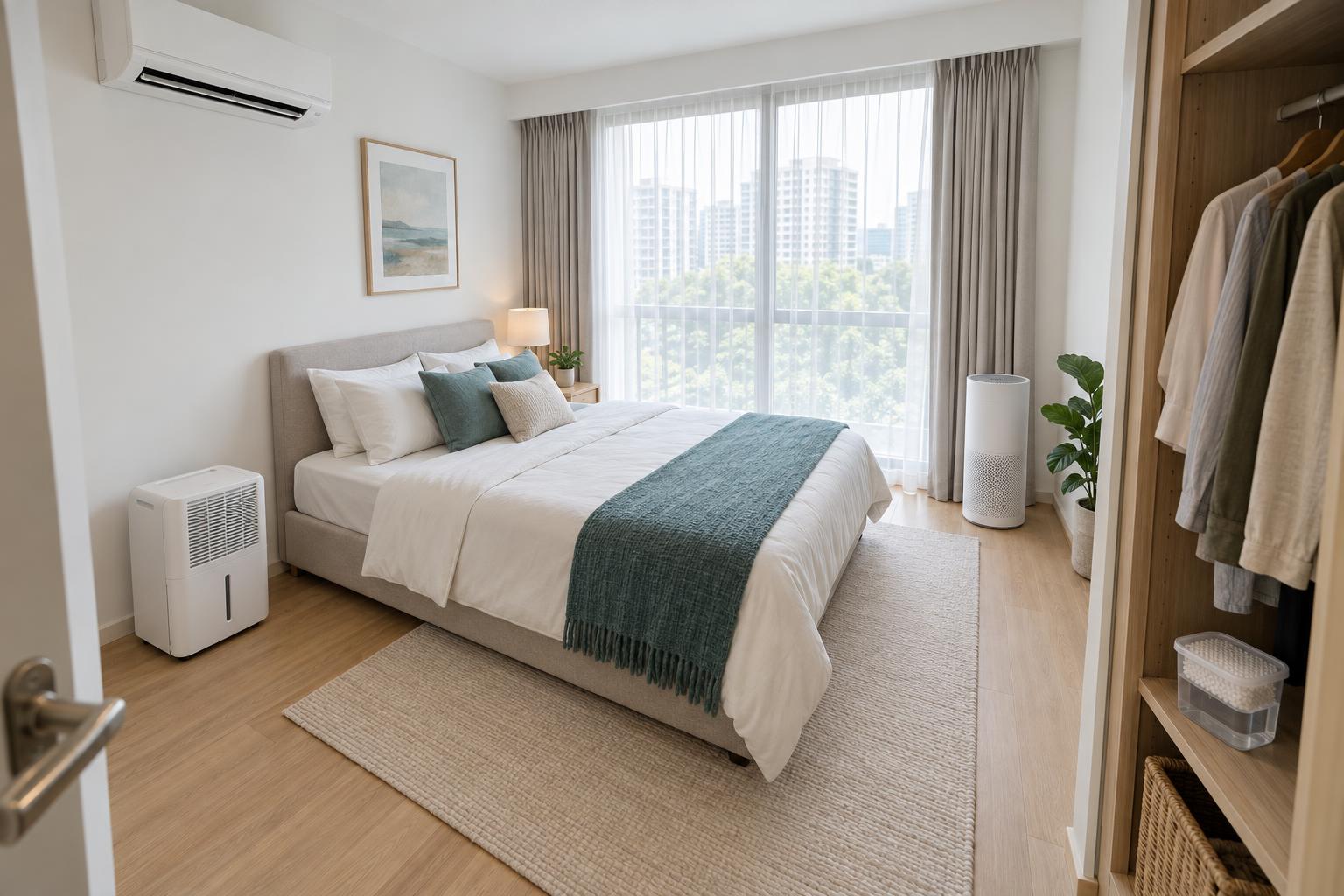
Most Singapore homes already own two of these four, and they do very different things about mould.
Four products, four different jobs. Only two of them lower humidity.
| Option | What it does | What it does about mould | Best for |
|---|---|---|---|
| Aircon dry mode | Runs the aircon gently to pull moisture out with less cooling | Lowers humidity while it's on. Nothing when it's off | Bedrooms that already have an aircon, on wet days and evenings |
| Dehumidifier | Pulls water out of the air into a tank, and can run all day | Keeps a closed room below 60% around the clock. Prevents new growth | Rooms that stay shut, rooms without aircon, storerooms, trips away |
| Moisture absorber tub (calcium chloride) | Crystals soak up a small amount of water from enclosed air | Helps a little in a closed cupboard. Useless for a whole room | Wardrobes, shoe cabinets, drawers |
| Air purifier with HEPA filter | Traps particles, including some mould spores, from the air | Nothing for humidity, so mould keeps growing on surfaces | Allergy relief and haze. Not mould prevention |
Is aircon dry mode enough?
Often, yes, for a bedroom you sleep in. Dry mode runs the aircon's fan slowly over a cold coil so it pulls out moisture without chilling the room as much as cool mode does. The catch is that it only works while it's on. Many households run the aircon a few hours a night, then the room sits closed and humid for the other sixteen. If the mould is in that kind of room, dry mode alone usually isn't enough. Whether dry mode uses less power than cool mode depends on the model, so check your aircon's manual rather than trusting a general claim.
An aircon that hasn't been serviced in a long time can itself hold mould in its coil and drip tray, and the EPA specifically says to keep aircon drip pans clean and drain lines flowing. If the musty smell gets worse when the aircon switches on, look there before you buy anything.
Moisture absorber tubs for wardrobes
The supermarket tubs (Thirsty Hippo is the best-known brand here) are calcium chloride crystals that pull water from the air and collect it as liquid underneath. A typical 600 ml tub is meant to be replaced within two to three months, or when the liquid reaches the line marked on the side. In a closed wardrobe or shoe cabinet they help. In an open room they're a drop in the ocean, because the room holds far more moisture than a tub can absorb.
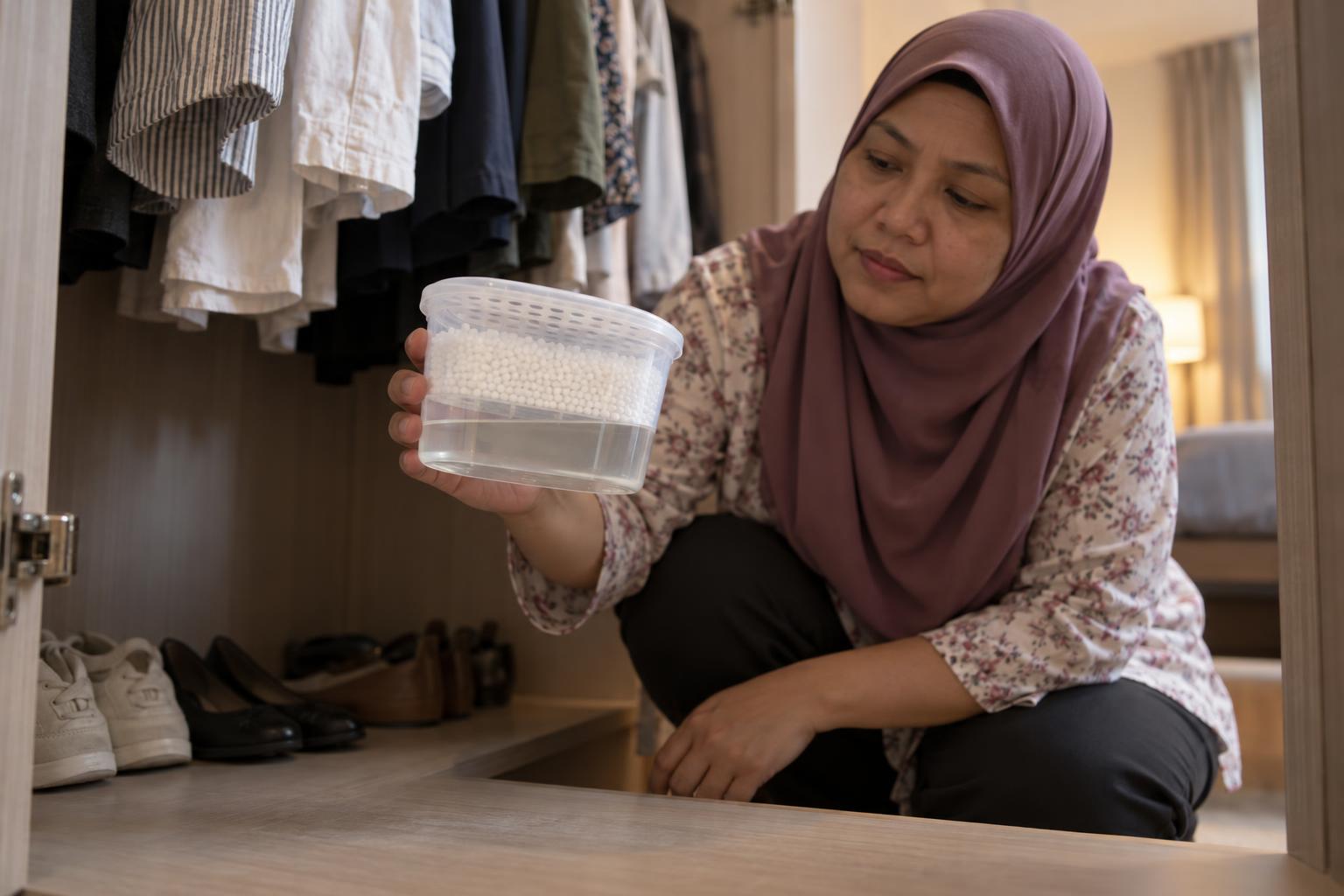
If your clothes or bags have already gone mouldy, the tub won't save them. Our guides to removing mould from clothes and mould on leather bags and shoes cover the cleaning, and both come back to the same fix: a drier room.
Air purifier vs dehumidifier
If you're buying for mould, buy the dehumidifier. An air purifier with a true HEPA filter traps airborne particles, including some spores, which can help people with allergies or during haze season. But it doesn't change humidity, so the mould on the wall keeps growing. Combination units that do both exist. They're fine, but check what a replacement filter costs before you buy, because that's where the running cost hides.
How to Choose One (Without Being Misled by the Box)
Compressor, not desiccant
There are two main types. Compressor dehumidifiers work like a small aircon, cooling a coil so water condenses on it. Desiccant dehumidifiers pass air over a moisture-absorbing material and then heat it to dry it out again. Desiccant units shine in cold, unheated rooms in places like the UK. In Singapore, where rooms stay warm all year, a compressor model is more efficient and doesn't pump extra heat into a room you're probably already trying to keep cool. Desiccant units are quieter, which is their one real advantage here.
The capacity trap
Every listing quotes a capacity in litres per day, and this is where most buyers get misled. That number depends heavily on the temperature and humidity it was tested at. Hong Kong's Consumer Council tested 12 dehumidifiers in 2014 and found manufacturers using two sets of test conditions, one of them in their own favour.
"The claims of dehumidifying capacity between the two sets of conditions effectively differed by over 60% and in some cases, even by 100% or more (for example, difference between 12.5 litres and 28 litres per day)."
— Consumer Council of Hong Kong, CHOICE magazine, 2014
The flattering condition is usually 30°C and 80% humidity. The ANSI/AHAM standard condition, which the Council treats as more realistic, is 26.7°C and 60%. In an earlier test the Council found that 9 of 12 models were rated at 30°C and 80%, and criticised that because humidity falls as soon as the machine starts working in a closed room, so it never stays that high. You can read the 2014 findings and the 2010 findings on the Council's site.
Our slightly contrarian take: the litres figure matters less than people think. What you actually want is a machine that holds a closed room at 55%. Any sensibly sized compressor unit with a working humidity setting will do that in a bedroom. Bigger isn't better if it's twice as loud. So compare models only on the same test condition, and if a listing doesn't say which condition it used, assume it's the flattering one.
The features that actually matter
- A humidity setting you choose (a humidistat). This lets you set 55% and have the machine switch itself off when it gets there. Without one, it just runs, and you pay for it.
- Automatic shut-off when the tank is full. Standard on almost everything now, but check.
- A continuous drain outlet. A hose to a floor trap means no tank to empty and no standing water, which matters for the next section. Very useful in a storeroom or bathroom-adjacent room.
- Noise, in decibels, if it's going in a bedroom. Lower is better, and night or sleep modes help.
- Auto-restart after a power cut, so it carries on while you're away.
- A washable filter and a tank that's easy to reach inside and scrub.
- A local service centre and warranty. A dehumidifier is a compressor appliance, and you want someone in Singapore to fix it.
Bought a dehumidifier and the mould came back anyway?
That usually means the moisture is coming from the building, not the air. Show us on a free video call and we'll tell you honestly which one it is.
What Size for Your Room
This is our rough guide, worked out from the 30°C / 80% capacity figure that most Singapore listings use. If a model quotes the standard 26.7°C / 60% figure, expect the number to be much lower for the same machine. Size up for a room that's damp, poorly ventilated or full of stored things.
A rough guide only. The right size is the one that holds the room at 55% without running flat out.
| Space | What to use | Rough capacity on the label | Notes |
|---|---|---|---|
| Wardrobe, shoe cabinet, drawers | Absorber tub, or nothing if the room is dry | Not applicable | Keep the room dry first. A tub only handles the enclosed air |
| Bedroom or study, closed door | Compact compressor dehumidifier | Around 10 to 12 L/day | Most HDB and condo bedrooms. Run it with the door and windows shut |
| Storeroom or household shelter used for storage | Compact compressor unit with continuous drain if possible | Around 10 to 12 L/day | Stuffed, closed rooms are the worst for mould. Leave space for air to move |
| Living room, or a large open-plan space | Larger compressor dehumidifier | Around 16 to 20 L/day or more | Open-plan rooms are harder to keep dry. Close the space off if you can |
| Whole flat while you're away | One unit per closed room, or one in the worst room with internal doors open | Depends on the rooms | Use continuous drain or a large tank so it doesn't stop when full |
A dehumidifier works on the room it's in. One unit in the corridor won't dry three bedrooms with the doors shut. And it always works best with the windows closed. Running one with the window open is trying to dry the whole of Singapore, one room at a time.
What It Costs to Run
Less than most people fear. From 1 October to 31 December 2026 the regulated household tariff is 28.59 cents per kWh before GST, about 31.16 cents with GST. The wattage is printed on your unit's label. As a worked example, take a 250 W compressor unit:
A worked example at the Q4 2026 tariff including GST. Tariffs change every quarter, and retailer plans differ.
| How you run it | Energy used | Cost per day | Cost per month (30 days) |
|---|---|---|---|
| 8 hours a day, compressor on the whole time | 2 kWh | About S$0.62 | About S$19 |
| 24 hours a day, compressor on the whole time | 6 kWh | About S$1.87 | About S$56 |
| 24 hours a day, set to 55%, cycling off when the room is dry | Less than the line above | Usually well under S$1.87 | Depends how damp the room is |
The last row is the realistic one. With a humidity setting, the compressor switches off once the room reaches 55% and only kicks back in when it drifts up. Is it OK to run a dehumidifier 24 hours a day? Yes, if it has a humidistat and either a continuous drain or auto shut-off when the tank is full. That's what they're designed for. Just keep the filter clean so it isn't straining.
What You'll See on the Shelf in Singapore
You'll find brands like Novita, Xiaomi (including its Deerma models), Mitsubishi Electric, Sharp, Midea, EuropAce and Philips at the big electrical chains and online. We haven't lab-tested them, so we're not going to rank them or hand out stars. Anyone who gives you a "best overall" without saying how they tested it is guessing, or selling.
Instead, run each model you're considering through this checklist:
- Is it a compressor model?
- Which test condition is the litres-per-day figure measured at? If it doesn't say, treat it as the flattering 30°C / 80% figure and compare accordingly.
- Can you set a target humidity, and does it switch off when it gets there?
- Does it have a continuous drain outlet?
- What's the power rating in watts, and the noise level in decibels?
- For combination dehumidifier-purifiers: what does a replacement filter cost, and how often does it need changing?
- Who services it in Singapore, and for how long is the warranty?
A mid-priced compressor unit that ticks those boxes will do more for mould than an expensive one with extra features you'll never use. Smart app control is nice. A humidity setting is essential.
Mould Inside Your Dehumidifier (and That Musty Smell)
A dehumidifier collects water and keeps it in a dark, warm plastic tank. Leave it a few days and you get black specks in the corners, a pink slimy film at the waterline, and a musty smell that the machine then blows around the room. Dust on the filter and the coil adds to it. We see this a lot in homes where the dehumidifier was bought to fix a smell and ended up becoming one.
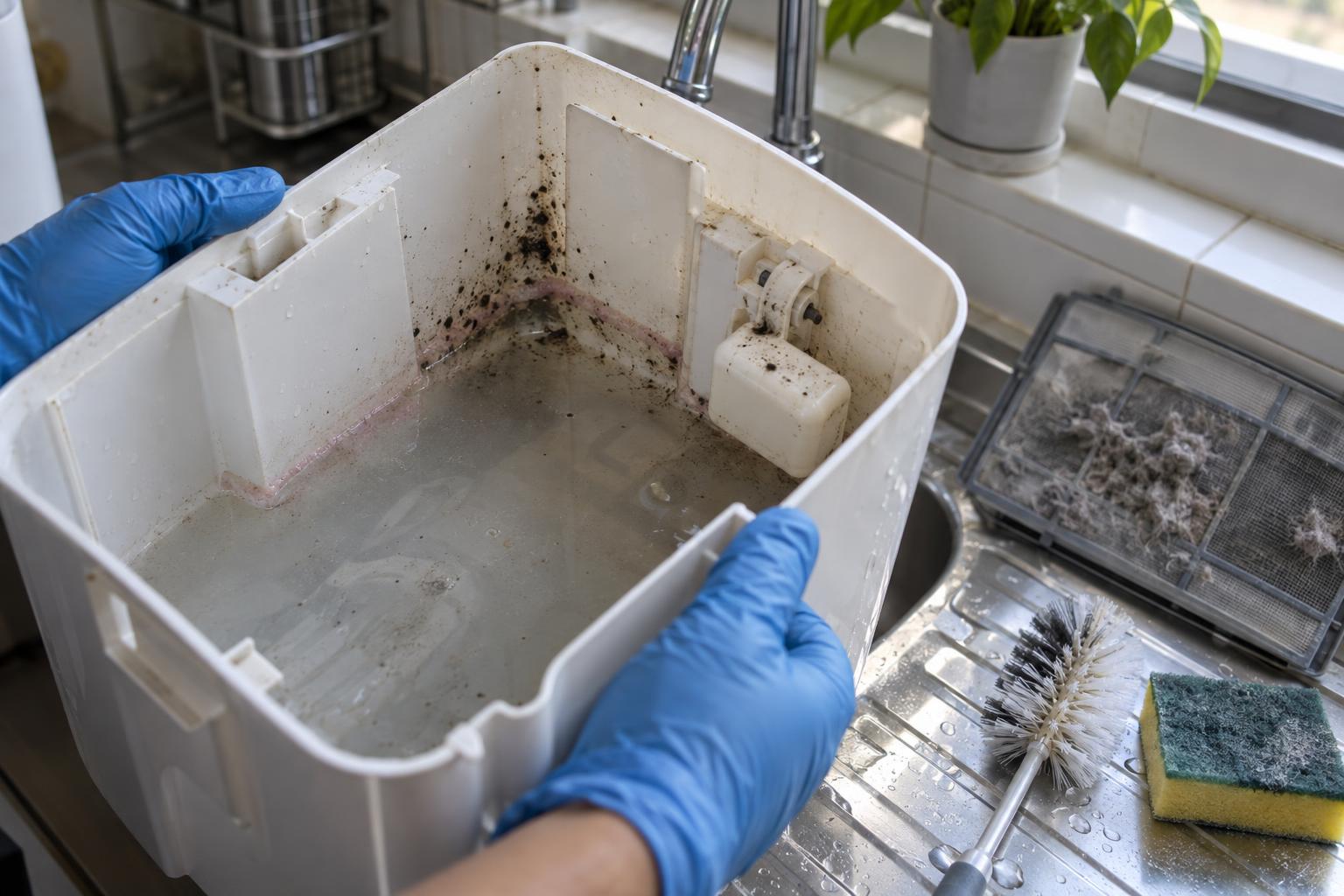
Cleaning it takes ten minutes. Always check your model's manual first, because the parts and what can go in water differ between brands. Then:
Unplug it and empty the tank
Pour the water down the sink, then take the tank to the sink to wash.
Wash the tank with mild detergent and warm water
Use a bottle brush or sponge on the corners, the float and anything that hinges, since that's where the growth hides. Don't put it in the dishwasher unless the manual says you can.
For stubborn black spots, use undiluted white vinegar
Pour or spray it on the affected areas and leave it for at least 15 minutes, longer on established growth, then scrub and rinse thoroughly.
Clean the filter
Vacuum or rinse it as the manual says. Let it dry completely before refitting. A damp filter goes musty fast.
Wipe the outside and grilles, and dry everything
Let the tank air-dry fully before it goes back in. Never spray cleaner into the machine itself, onto the coil or into the electrics.
How often? In Singapore, we'd empty the tank daily if it's filling, wash it weekly, and clean the filter every one to two weeks. That's a little more often than some manuals suggest, but the manuals are written for cooler countries. A continuous drain hose removes most of the problem, because there's no standing water at all.
If it still smells musty after a clean
Then the growth is probably on the internal coil, which you can't safely reach. Take it to the brand's service centre. And if the room still smells musty with the machine switched off and cleaned, the smell isn't coming from the dehumidifier. It's the room, and the source is worth finding.
A faint warm-air smell when a new unit first runs is normal. A damp, earthy, musty smell is not.
When a Dehumidifier Isn't the Answer
From Our Experience
The call we get most about dehumidifiers goes like this: the family bought one, ran it for a month, the hygrometer says 55%, and the mould is back in the same corner. Usually the corner is the clue. Mould that keeps returning to one spot, while the rest of the room stays clean, is being fed by something local: a window that lets rain in, a bathroom wall on the other side, a cold patch where the aircon blows, or a gap behind built-in carpentry with no airflow. The machine is drying the air while the water comes in somewhere else.
Look at getting the room checked if:
- Mould keeps coming back in the same spot even with the room held at 55%
- It's on one wall, under a window, or around a pipe, rather than spread through the room
- Paint is bubbling or flaking, or there's a water stain
- The room smells musty but you can't find any visible mould
- It covers more than about one square metre (roughly 10 square feet)
Our mould inspection is a visual inspection with humidity and surface moisture readings, which is how you tell a humidity problem from a water problem. If you want to know what's in the air rather than on the walls, that's indoor air quality testing. And if the growth is already established, mould removal deals with it, after which a dehumidifier is a good way to keep it from coming back.
For cleaning the mould you've already got, start with our guides to mould on walls, mould on the ceiling and mould on wood furniture, or our comparison of mould removers sold in Singapore.
Not sure if it's the air or the building?
Send us a photo on WhatsApp. We'll tell you straight whether a dehumidifier will sort it or whether something needs a proper look.
Frequently Asked Questions
Does a dehumidifier help with mould?
What humidity should I set my dehumidifier to in Singapore?
Can a dehumidifier kill mould?
Is aircon dry mode as good as a dehumidifier?
How much does it cost to run a dehumidifier in Singapore?
Is it OK to run a dehumidifier 24 hours a day?
Should I get a humidifier or a dehumidifier for mould?
How do I get rid of mould inside my dehumidifier?
What we do and don't do
Mold Busters Singapore finds moisture problems and treats mould in buildings. We don't sell dehumidifiers, air purifiers or moisture absorbers, and we have no arrangement with any brand mentioned in this guide. Brands are named only because they're what you'll find in Singapore shops.