

 John Ward
You have had a blocked nose for three weeks, the cough will not shift, and you have just found a dark patch behind the wardrobe. So here is the honest version. Mould exposure is well documented to cause allergic and irritant symptoms: a blocked or runny nose, coughing, wheezing, itchy eyes and throat, skin irritation, and worsened asthma in people who already have it. Those effects are real and they are the reason to deal with damp promptly. What is not established is the dramatic end of what you will read online, the idea that household mould poisons you through mycotoxins and causes a long list of unrelated illnesses. The US Centers for Disease Control, the World Health Organization and the Institute of Medicine have all landed in roughly the same place on that.
We inspect buildings for a living, so let me be clear about the limits of this article. Nothing here is a diagnosis and none of it replaces seeing a doctor. What we can tell you about is the building side: what the evidence associates with damp indoor spaces, what to look for in a Singapore flat, and how to work out whether your home is actually the thing making you feel rubbish.
And one local finding worth putting up front, because almost nobody mentions it. In Singapore, if someone in your household has allergy symptoms, mould is usually not the first suspect. Dust mites are, by a wide margin. We will get to the study behind that, and to the genuinely odd thing it found about air-conditioning.
This is general information, not medical advice
This article summarises published research on mould and health. It cannot tell you what is causing your symptoms. If you feel unwell, see a doctor or a polyclinic. We assess buildings, not people, and no inspection or air test can diagnose a medical condition.
Key Takeaways
- Well documented: nasal congestion, cough, wheeze, eye and throat irritation, skin irritation, and worsened asthma in people who already have asthma
- The Institute of Medicine found sufficient evidence linking indoor damp and mould to upper respiratory symptoms, cough and wheeze in otherwise healthy people
- Not supported by the evidence: mycotoxin poisoning from ordinary household mould exposure, which ACOEM and the Institute of Medicine both consider highly improbable at home and office exposure levels
- Higher risk groups are people with asthma, existing allergies, weakened immune systems or chronic lung conditions, plus young children and elderly residents
- In one Singapore study of 202 children with allergic rhinitis, 97% were sensitised to dust mites and only 19% to moulds
What Mould Exposure Actually Does
The research on this is better than people assume. It just does not say what the scarier websites claim it says. Health authorities sort the evidence into tiers, from effects with solid backing down to claims that studies have looked for and not found. Sorting it that way makes the picture much easier to read.
How health authorities grade the evidence on indoor damp and mould
| Effect | How strong is the evidence | Who it affects most |
|---|---|---|
| Upper respiratory symptoms, cough, wheeze | Sufficient evidence of association, per the Institute of Medicine | Otherwise healthy people, so anyone |
| Worsened asthma symptoms | Sufficient evidence of association | People who already have asthma |
| Hypersensitivity pneumonitis | Sufficient evidence, though the condition itself is uncommon | Susceptible individuals only |
| Allergic rhinitis, eczema, respiratory infections | Reported in occupants of damp buildings | Sensitised and atopic people |
| Eye, nose, throat and skin irritation | Well documented as an irritant effect | Anyone, including people with no allergy |
| Development of new asthma | Evidence of an association with damp indoor spaces | Children especially |
| Mycotoxin poisoning from breathing household mould | Not supported. Considered highly improbable at home exposure levels | No established group |
Notice the pattern in that table. Everything with strong evidence behind it is allergic, irritant or respiratory. That is what mould does. It is an allergen and an irritant, and for a meaningful slice of the population it is a genuine problem that makes daily life worse. It is not a poison in the way the internet uses the word.
The other thing worth knowing is that dampness itself matters, not just visible mould. Studies of damp buildings find these symptom patterns in occupants whether or not anyone has identified a mould colony on a wall. Wet building materials support mould, bacteria, and chemical breakdown of the materials themselves, and untangling which one is responsible for a given cough is not something a test can do for you.
From Our Experience
From our field work in Singapore homes: the symptom pattern that actually tracks with a mould problem is the one that follows the building, not the season. Hay fever style symptoms that ease when you travel and return within a day or two of coming home point at something indoors. Symptoms that stay constant wherever you are usually have nothing to do with your flat.
Warning Signs Worth Acting On
Search for this topic and you will find plenty of "10 warning signs of mould toxicity" checklists, usually ending with an invitation to buy something. We are going to reframe that list, because a symptom checklist cannot tell you what you have. Treat these as signs that your building deserves a look, not as a score card for your health.
Ten signs that warrant checking the property, not self diagnosing
| What you notice | Why it points at the building |
|---|---|
| Congestion or a runny nose that clears when you are away from home | The most useful single signal, because it follows the location rather than you |
| A cough that is worse in the morning after a night indoors | Overnight exposure in a closed bedroom with the aircon running |
| Itchy or watering eyes in one specific room | Localised source, often a wardrobe, aircon unit or bathroom wall |
| Asthma that has become harder to control at home | Damp is an established asthma trigger and worth telling your doctor about |
| A musty smell you stop noticing until you return from a trip | Smell fatigue is real. Coming home after a week resets your nose |
| Skin irritation on areas touching stored fabric or bedding | Contact with mould affected textiles rather than airborne exposure |
| Symptoms that started after a leak, flood or renovation | A clear water event gives you a timeline to work backwards from |
| Visible dark growth, peeling paint or a bulging ceiling patch | You do not need a symptom to justify acting on this one |
| Condensation on walls or windows most mornings | Sustained surface moisture is what lets colonisation start |
| More than one household member with the same symptoms | Shared environment is a stronger clue than any individual symptom |
When to seek medical care rather than a building inspection
Some symptoms need a doctor now, not an inspection. Shortness of breath or difficulty breathing, chest tightness or pain, coughing up blood, a persistent fever, or a sudden severe worsening of asthma all need urgent medical attention. Go to a doctor or A&E. This applies whatever you think the cause is, and it applies before any decision about your property.
That alert is deliberately not followed by a sales pitch. If you are short of breath, the state of your wardrobe backing is not the priority.
Allergy Versus Poisoning
These two ideas get blended together constantly, and separating them is probably the single most useful thing this article can do.
Mould allergy is an immune response. Your body treats mould spore proteins as a threat and produces the standard allergic reaction: congestion, sneezing, itchy eyes, sometimes asthma symptoms. It is diagnosable by a doctor through skin prick or blood testing, it is common, and it is well understood. Some people have it and most people do not.
Mould irritation is not an allergy at all. Spores, fragments and the compounds that make mould smell musty can irritate eyes, nose, throat and lungs in people with no allergy whatsoever. This is why someone can react in a damp room while testing negative for mould allergy, and it often gets misread as evidence of something more exotic.
Mould "poisoning" or "toxicity" is where things get murky. Mycotoxins are real chemicals and some moulds produce them, which is why the concept sounds plausible. The question is whether breathing them at the concentrations found in an ordinary damp home causes systemic illness. The American College of Occupational and Environmental Medicine and the Institute of Medicine both concluded that the evidence does not support mycotoxin mediated disease through inhalation outside occupational settings, and that the mycotoxin quantity carried per spore makes toxic effects from household exposure highly improbable.
"Mould is an allergen and an irritant. That is enough of a reason to fix a damp problem. It does not need to be a poison as well."
— John Ward, Account Executive, Mold Busters
Here is the part that frustrates people, and fairly so. Saying the toxicity model lacks evidence is not saying your symptoms are imaginary. Plenty of people genuinely do feel better after a damp problem is fixed. The allergic and irritant pathways explain a great deal of that on their own, and so does simply living somewhere drier and cleaner. You do not need a poisoning narrative to justify sorting out a wet wall.
Skin Rash From Mould
This comes up often enough to deserve its own section. Mould exposure can produce skin symptoms, usually as contact irritation or as part of an allergic response in someone already sensitised. Typically that looks like patches of dry, itchy, reddened skin, sometimes with small bumps, on areas that have been in contact with affected material. Eczema flares in people who already have eczema are also reported in damp housing.

What we would gently push back on is the assumption that a rash means mould. Singapore is an excellent place to develop a skin complaint for reasons that have nothing to do with fungal growth on your walls. Heat rash, sweat and friction, contact dermatitis from detergent, and dust mite driven eczema are all extremely common here. A doctor can distinguish between these. A mould inspector cannot, and any inspector who tells you your rash is definitely from mould is guessing well outside their competence.
The one situation where the building link is worth taking seriously is a rash that appears on skin contacting specific stored items, clothes from the back of a wardrobe, bedding from a storeroom, a mattress against an external wall. That is a material problem you can act on. Our guides on removing mould from walls and dealing with affected clothes and fabrics cover the practical side.
Not Sure If Your Home Is the Problem?
An indoor air quality assessment measures what is actually in your air and compares it against outdoor samples taken the same day. It tells you about the building, which is the part we can help with.
Who Gets Hit Hardest
Mould does not affect everyone equally, and the gap between groups is wide. Most healthy adults in a mildly damp flat notice very little. For some households it is genuinely disruptive.
97%
SG allergic rhinitis children sensitised to dust mites
19%
Same group sensitised to moulds
~80%
Singapore average relative humidity
24-48h
Time for spores to colonise damp material
Households where damp deserves faster attention
People with asthma, existing allergies, chronic lung conditions such as COPD, or weakened immune systems from illness or medication. Young children and elderly residents also tend to be more affected. If that describes someone at home, they should not be the person scrubbing a mould patch, and a recurring damp problem is worth resolving sooner rather than tolerating.
Immunocompromised people are the group where mould can cause something beyond allergy. Certain moulds, Aspergillus in particular, can cause actual infection in people with severely weakened immune systems. That is a real and serious clinical issue, it is managed by doctors, and it is rare in the general population. It is also not what is happening to a healthy adult with a stuffy nose, and conflating the two is how the fear gets manufactured.
What Actually Helps
For most households the useful interventions are dull and effective. Keep indoor humidity in the 50 to 60% range with a dehumidifier or by running aircon rather than opening up on the wettest days. Run bathroom exhaust fans for 20 minutes after showering, not just during. Service aircon units so condensate drains properly instead of pooling.
Fix leaks quickly. A slow drip behind a cabinet does more damage over six months than a dramatic burst pipe does in a day, because nobody notices it.

The Singapore Picture
Almost every article on this subject is written for American homes, and it shows. Here is what the local evidence says instead, because it changes the practical advice.
A study of 202 Singaporean children with allergic rhinitis, published in Pediatric Allergy and Immunology in 2004 by Kidon and colleagues, tested which airborne allergens they actually reacted to. House dust mites came back at 97%. Pets at 20%. Moulds at 19%. Pollens at 15%. In a tropical city where mould grows on everything, mould sensitisation was still a distant third.
So if your child has persistent allergy symptoms in a Singapore flat, the odds strongly favour dust mites over mould. That is worth knowing before you spend money on the wrong problem. It does not mean mould is irrelevant, and the two often coexist in the same humid bedroom, but the order of suspicion matters.
The counterintuitive finding
The same study found mould sensitisation was 49% in homes without air-conditioning, against 10% in homes with it. Polysensitisation followed the same pattern, 51% versus 14%. Air-conditioned homes stay closed and drier, which appears to reduce mould allergen exposure despite aircon being a frequent cause of condensation problems. Both things are true at once, and it is a useful reminder that a sealed dry flat and a damp one behave very differently even in the same climate.
We find that finding genuinely awkward, since we spend a lot of time explaining that aircon condensation causes mould. Both hold. Running aircon keeps a flat drier overall and limits what blows in from outside. Running it badly, with a blocked condensate line or cold surfaces meeting humid air, creates exactly the wet patches we get called about. The machine is not the villain. Neglecting it is.
The wider Singapore context: average relative humidity sits around 80%, mould germinates from roughly 60% surface humidity upward, and spores colonise damp material within 24 to 48 hours. There is no dry season to reset things. Anything left wet stays wet, which is why the moisture source matters more than the mould you can see. Our guide to black mould in Singapore covers why most dark patches in concrete built HDB flats are not the species people fear.
What To Do If You Suspect It
Split the problem in two, because the two halves have different experts. Your body is a medical question. Your building is ours. Trying to answer one with the other is where people waste money.
For your health: see a doctor. Describe the pattern, not just the symptoms. Mention when it started, whether it eases when you are away from home, whether anyone else at home has it, and whether there has been a leak or flood. A GP can test for mould allergy if it looks relevant, and can rule out the many other things that produce the same symptoms. That last part matters more than people expect, because assuming mould and being wrong means the real cause goes untreated.
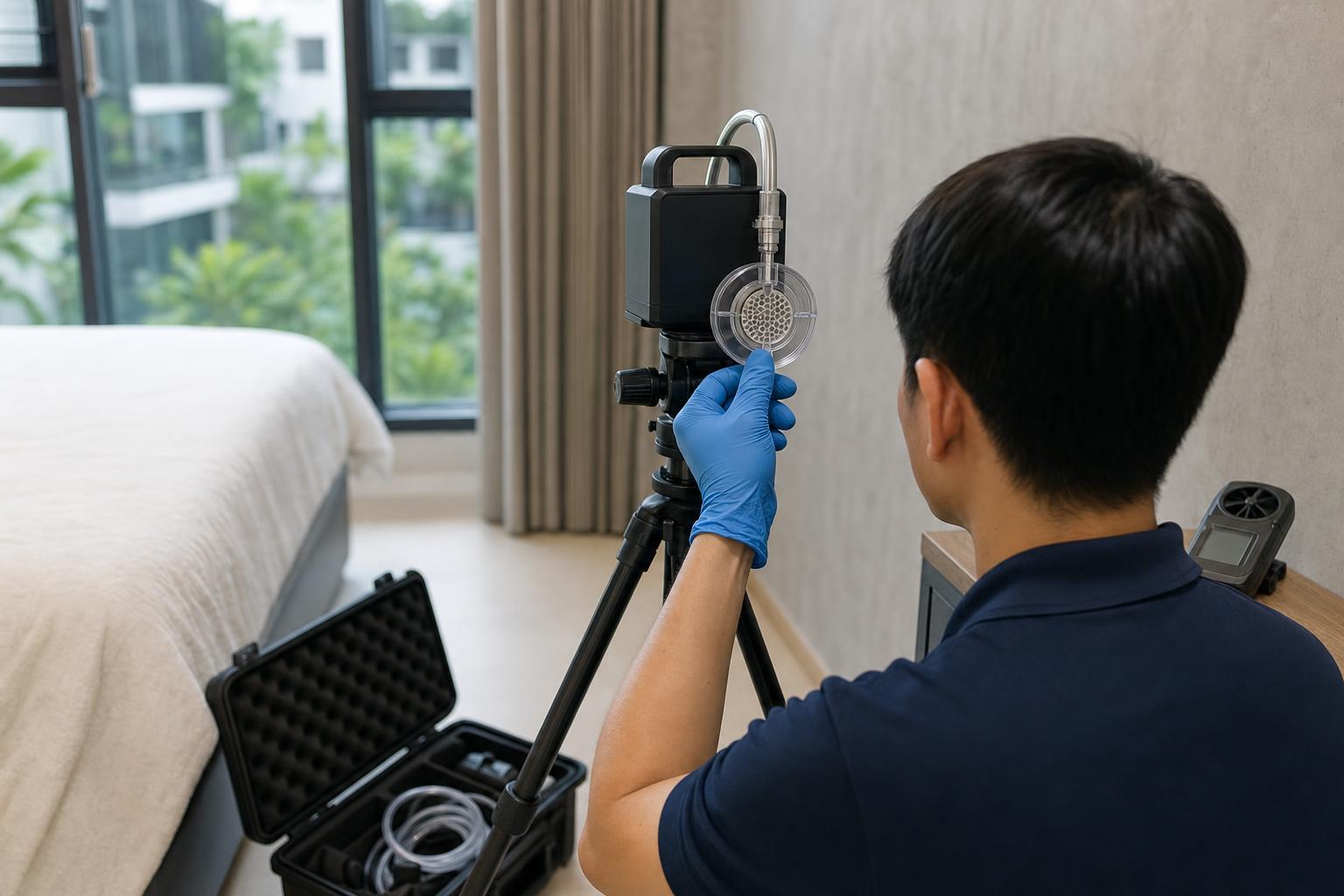
For your home: look for the water first. Check under sinks, behind and beneath the washing machine, around window seals after heavy rain, the aircon condensate tray and drain line, and the wall a wardrobe backs onto. Mould is a symptom of moisture, and treating it without finding the source just moves the appointment a few months down the road.
If there is visible growth under about one square metre on a hard surface like tile or painted concrete, that is usually a reasonable job to handle yourself with proper protection. Larger areas, growth on soaked material, anything recurring, or a household including someone in a higher risk group is where a professional inspection earns its keep. Air quality testing is worth it when you can smell or feel a problem but cannot find it.
From Our Experience
The away from home test is still the most useful thing you can do, and it costs nothing. Spend three or four nights elsewhere and pay attention to whether symptoms fade, then note how quickly they return once you are back. I lived through this myself years ago in a rented place, with fatigue and concentration problems that got put down to stress until a week away made the pattern obvious. Tell your doctor about that pattern. It is more informative than any species name on a lab report.
Why We Do Not Sell Mycotoxin Testing
There is a market for urine mycotoxin tests sold to diagnose "mould toxicity" in people. We do not offer them, and we would suggest treating them carefully.
A review published in the CDC's Morbidity and Mortality Weekly Report examined the clinical use of these tests in the United States and found them unvalidated for diagnosing illness. There is a further problem it flagged, which is that patients were being prescribed antifungal medication on the strength of the results. Antifungals treat fungal infections. They do not treat exposure to a toxin. The treatment did not match the claimed diagnosis.
We have a commercial interest in saying the opposite of this, which is precisely why it is worth saying. A company that leads with mycotoxin poisoning and offers you a same day quote before anyone has looked at where the water is coming from is running a sales process, not an assessment. Fear converts well. It just does not fix walls.
What building testing legitimately does: it tells you which spore types are present indoors and at what concentration relative to outdoor air on the same day, which is how active indoor growth gets identified. Surface sampling from a visible patch gives a clearer read on that specific spot. What it does not do is name every species definitively, and it cannot establish that a given mould caused a given person's symptoms. Our mould testing page sets out what the sampling actually delivers.